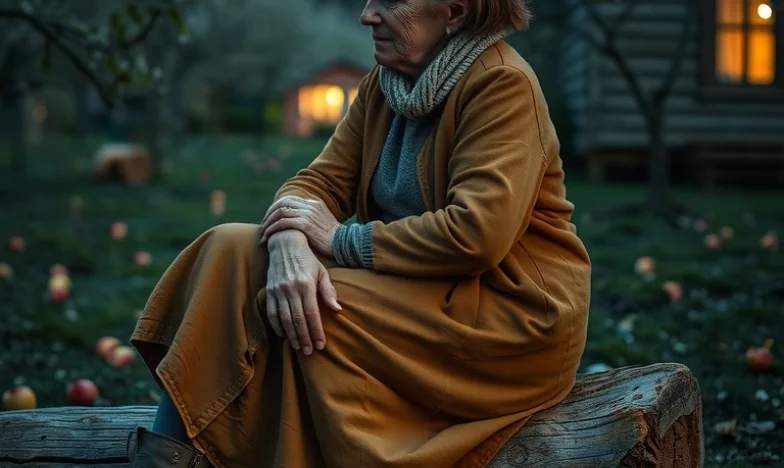
Not By Blood, But By Heart: A Mother’s Truth in the Village

“He’s not even yours, is he, Sarah?”
The words hit me like a slap, sharp and cold, echoing across the muddy lane outside the village shop. Mrs. Cartwright’s voice, shrill as a magpie, carried over the heads of the queue, and I felt every eye turn my way. I gripped the string bag tighter, the potatoes inside bruising under my fingers. Jamie, my eldest, stood beside me, his cheeks flaming red beneath his mop of brown hair. He was only twelve, but already he knew the sting of village gossip.
I wanted to shout back, to tell her that blood isn’t what makes a mother, but my voice caught in my throat. Instead, I turned to Jamie and managed a smile. “Come on, love. Let’s get home before the rain starts.”
Our cottage sat at the edge of the village, half a hectare of stubborn Norfolk clay and a small orchard that my husband, Tom, and I tended with more hope than skill. We grew carrots, potatoes, and runner beans, enough to fill our bellies and trade for eggs or a bit of fish from the neighbours. Life here was simple, but never easy. Work was scarce, and most families, like ours, scraped by on what they could coax from the land.
Tom had been married before, to a woman named Elaine. She’d left him and Jamie when Jamie was just a toddler, running off to London with a lorry driver. I met Tom a year later, when I came to the village to care for my ailing aunt. He was quiet, with kind eyes and hands rough from years of digging and mending. Jamie was shy, clinging to his father’s legs, his eyes wide and wary. It took months before he let me brush his hair or read him a story at bedtime.
The village never let me forget I wasn’t Jamie’s real mother. At first, it was little things—a raised eyebrow at the school gate, a whispered comment in the post office. But as Jamie grew, so did the rumours. Some said I was only after Tom’s land. Others whispered that I’d never love Jamie like my own. I tried to ignore them, but their words seeped into the cracks of our home, poisoning the air.
One evening, as I peeled potatoes by the fire, Jamie sat at the table, his homework spread before him. He looked up, his eyes troubled. “Mum, why do people say I’m not really yours?”
I set down the knife, my hands trembling. “Because some people think being a family is only about blood. But it’s not. I love you, Jamie. That’s what matters.”
He nodded, but I saw the doubt linger in his eyes. I wanted to protect him from the world, but I couldn’t shield him from the village’s narrow gaze.
Tom tried to help, but he was a man of few words. “Ignore them, Sarah,” he’d say, his arm around my shoulders. “We know what’s true.”
But the truth was, sometimes I wondered if I was enough. When Jamie fell ill with the flu, I sat by his bed all night, wiping his brow and whispering stories. When he won a prize at school for his drawing of the orchard, I cheered the loudest. But at the back of my mind, a voice whispered: You’re not his real mum.
The worst came one winter, when Jamie’s birth mother, Elaine, returned. She swept into the village in a cloud of perfume and city clothes, her laughter ringing out in the pub. She wanted to see Jamie, she said, to make up for lost time. Tom was wary, but Jamie was curious. “She’s my mum, too, isn’t she?” he asked, his voice small.
I tried to hide my fear. “Yes, love. She is.”
Elaine took Jamie to the seaside for a day. He came back with a bucket of shells and a sunburnt nose, talking about the arcades and the taste of candyfloss. For weeks after, he was distant, quiet at dinner, his eyes fixed on the horizon. I lay awake at night, listening to the wind rattle the windows, wondering if I was losing him.
One evening, as I tucked him into bed, he turned to me. “Mum, why did Elaine leave?”
I hesitated. “Sometimes grown-ups make mistakes. She loves you, in her way. But she couldn’t stay.”
He nodded, silent. Then, softly: “I’m glad you stayed.”
Tears pricked my eyes. “I’ll always stay, Jamie. Always.”
But the village wouldn’t let it rest. At the harvest festival, Mrs. Cartwright cornered me by the cake stall. “You know, Sarah, blood will out. That boy’s not yours, no matter how hard you try.”
I clenched my fists, the words burning in my chest. “He’s my son in every way that matters.”
She sniffed. “We’ll see.”
That night, I found Jamie sitting in the orchard, knees drawn to his chest. The moonlight silvered the apple trees, and the air was thick with the scent of fallen fruit.
“Are you all right, love?” I asked, sitting beside him.
He shrugged. “People say I don’t belong.”
I put my arm around him. “You belong with us. With me. Family isn’t just about who you’re born to. It’s about who stays, who loves you, who fights for you.”
He leaned into me, his head on my shoulder. “I wish people would stop talking.”
“So do I,” I whispered. “But we can’t change them. We can only be ourselves.”
The years passed. Jamie grew taller, his voice deepening, his laughter rarer. He worked the land with Tom, his hands growing calloused and strong. He brought home stray kittens and injured birds, nursing them back to health. He was kind, stubborn, and fiercely loyal.
When he turned eighteen, he told me he wanted to study agriculture at college in Norwich. I was proud, but my heart ached at the thought of him leaving. On his last night at home, we sat in the orchard, the trees heavy with fruit.
“Thank you, Mum,” he said, his voice thick. “For everything.”
I hugged him tight. “You’ll always be my boy.”
Now, the cottage feels emptier, the days quieter. The village still whispers, but I hold my head high. I know what I am. I am Jamie’s mother—not by blood, but by heart.
Sometimes, late at night, I wonder: Why do people care so much about blood, when love is what truly binds us? Would you say I’m not a real mother, just because I didn’t give birth to him? Or is being a family about something deeper, something chosen every single day?