The Recipe for Change

The waiting room was thick with the scent of burnt coffee and the kind of nerves that make your hands tremble even when you’re just holding a magazine. I stared at the faded NHS poster about blood pressure, trying not to think about the clock ticking above the receptionist’s head. My mother, Margaret, sat beside me, her lips pressed so tightly together they’d almost disappeared. She was always like that in hospitals—rigid, silent, as if she could will the world into order by sheer force of will.
“Do you think they’ll call us soon?” I whispered, my voice barely more than a breath.
She didn’t answer, just gave me that look—the one that said, ‘Don’t make a fuss, Emily.’ I bit my tongue, feeling the old resentment bubble up. It was always like this: me, desperate for reassurance; her, determined to show none.
The nurse finally called our name, and we shuffled in, the soles of my trainers squeaking on the linoleum. The doctor’s office was small, cluttered with files and the faint smell of antiseptic. He spoke in that careful, measured way doctors do when they’re about to deliver news that will change everything.
Afterwards, we walked home in silence. The diagnosis hung between us like a storm cloud—my mother’s heart was failing, and the waiting list for surgery was long. Too long, perhaps. I wanted to scream, to cry, to demand answers, but all I could do was clutch my bag and follow her up the cracked path to our terraced house in Sheffield.
That night, I couldn’t sleep. I wandered into the kitchen, the old tiles cold beneath my feet, and stared at the shelves lined with cookbooks. My mother had always cooked—stews that simmered all day, cakes that filled the house with warmth. I reached for her oldest book, the one with the faded spine and flour-dusted pages. Maybe, I thought, I could make her something. Something that would help, even if just for a moment.
As I flipped through the pages, a yellowed envelope slipped out and fluttered to the floor. I picked it up, curious. Inside was a small, tarnished key and a note, written in my grandmother’s spidery hand: ‘For when you need to find your way back.’
I stared at the key, my heart pounding. What was this? I’d never seen it before. I turned the note over, searching for clues, but there was nothing else. Just those cryptic words.
The next morning, I confronted my mother. “Mum, do you know anything about this?” I held out the key and the note.
She went pale, her hands trembling as she took them from me. “Where did you find this?”
“In your old cookbook. What does it mean?”
She hesitated, her eyes darting to the window. “It’s nothing. Just an old family thing. Best forget about it.”
But I couldn’t. The key burned in my pocket all day, a mystery I couldn’t let go. That evening, after my mother had gone to bed, I searched the house. I tried the key in every lock I could find—drawers, cupboards, even the old shed at the bottom of the garden. Nothing.
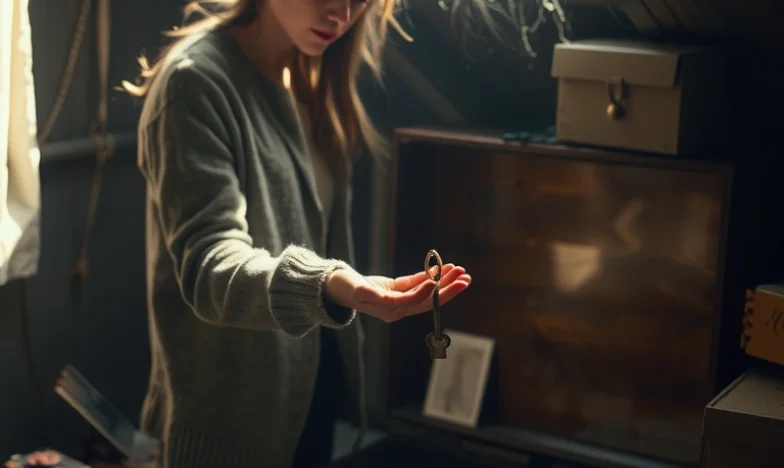
It wasn’t until I remembered the attic, the one place my mother never let me go, that I realised where it must fit. I crept up the narrow stairs, the key clutched in my sweaty palm. The lock was stiff, but it turned with a satisfying click.
Inside, the attic was dark and musty, filled with boxes and old furniture. I found a trunk in the corner, its lid heavy with dust. The key fit perfectly. Inside were letters, photographs, and a diary bound in cracked leather.
I sat on the floor, my heart racing as I read. The diary belonged to my grandmother, Elsie. She wrote about the war, about rationing and fear, but also about love—love for a man who wasn’t my grandfather. The letters were from him, full of longing and regret. There were photographs, too: my grandmother, young and laughing, her arm around a man I didn’t recognise.
I felt dizzy. My whole life, I’d believed in the stories my mother told me—about family, about loyalty, about sacrifice. But here was proof that things were never so simple. My grandmother had loved someone else, had kept secrets, had made choices that rippled down through the years.
I confronted my mother again, the diary in my hands. “Why didn’t you tell me?”
She looked at me, her eyes shining with tears. “Because it hurt too much. Because I wanted to protect you. Because I didn’t want you to make the same mistakes.”
We argued, voices rising in the quiet house. I accused her of lying, of hiding the truth. She accused me of not understanding, of being too young to know what love and loss really meant. In the end, we both cried, the years of silence and resentment spilling out at last.
In the weeks that followed, as my mother’s health worsened, we talked more than we ever had. She told me about her childhood, about the man her mother had loved, about the choices that had shaped our family. I realised how much she’d carried alone, how hard she’d tried to protect me, even when it meant building walls between us.
I started cooking for her, using recipes from the old book. Each meal was a small act of love, a way to bridge the gap between us. We laughed, sometimes, over burnt toast or lumpy gravy. We cried, too, over memories and regrets.
When the call finally came—there was a space for her surgery—I felt a strange mix of relief and terror. We went to the hospital together, hand in hand. I waited for hours, pacing the corridors, praying for a miracle.
She survived. The recovery was slow, but she grew stronger each day. We spent long afternoons in the garden, talking about the past, about forgiveness, about the future. I realised that families are built on secrets as much as on love, and that sometimes, the only way to heal is to face the truth, no matter how painful.
Now, when I look at the old cookbook, I see more than just recipes. I see a map of our lives—messy, complicated, but full of hope. I wonder how many other families are hiding secrets in dusty attics, how many daughters are searching for answers in the middle of the night.
Do we ever really know the people we love? Or are we all just trying to find our way back, one small key at a time?