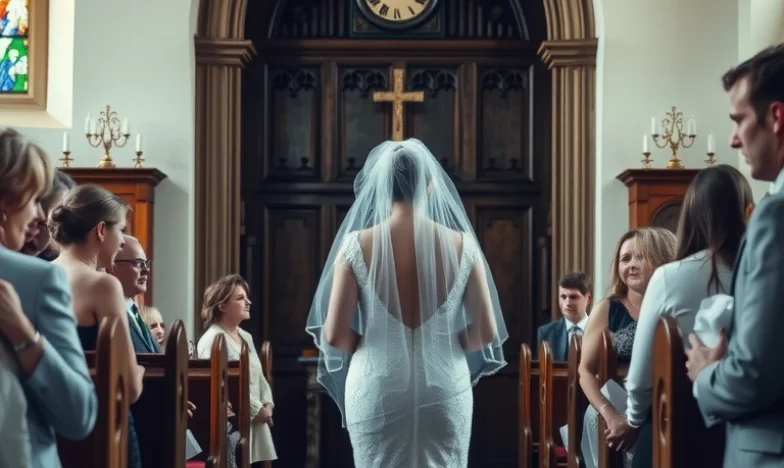
The Wedding That Never Was: Kinga’s Story

“He’s not coming, is he?” Mum’s voice trembled as she gripped my hand, her knuckles white against the delicate lace of my dress. The church was cold, the air thick with the scent of lilies and anticipation, but all I could hear was the echo of my own heartbeat, thudding in my ears like a warning bell. I stared at the heavy oak doors, willing them to swing open, for Tom to burst in, breathless and apologetic, with some ridiculous story about traffic on the M25 or a flat tyre. But the clock on the wall ticked on, relentless, and the pews behind me filled with whispers and shifting feet.
I’d always been a dreamer. As a little girl in Sheffield, I’d watched wedding scenes on telly with wide eyes, clutching a pillow to my chest, imagining the day I’d walk down the aisle in a cloud of white. My parents, Polish immigrants who’d worked themselves to the bone for a better life, always told me to keep my feet on the ground. But I couldn’t help it. I wanted the fairy tale. I wanted the love story.
Tom was my first real love. We met at university in Leeds, both of us awkward and shy, bonding over late-night study sessions and cheap instant noodles. He made me laugh, made me feel seen in a way no one else ever had. When he proposed last Christmas, in front of the twinkling lights of the city centre, I thought my heart would burst. I said yes before he’d even finished asking.
Now, standing in the church, my hands shaking, I felt the weight of every hope I’d ever had pressing down on me. My friends hovered nearby, their faces pale and anxious. My father paced the aisle, muttering in Polish, his anger simmering just beneath the surface. My younger sister, Ania, tried to make jokes, but her voice cracked with worry.
The vicar approached, his expression gentle but firm. “Kinga, love, we can wait a little longer, but…”
I nodded, swallowing hard. “Just a bit more. He’ll come. He promised.”
But as the minutes dragged on, the truth settled in my chest like a stone. Tom wasn’t coming. He hadn’t called, hadn’t texted. His parents, sitting in the front row, looked as bewildered as I felt. I caught his mother’s eye, and she shook her head, tears glistening on her cheeks.
The guests began to murmur, some slipping out quietly, others lingering in awkward clusters. My aunt Magda tried to comfort me, her arms warm and familiar, but I pulled away. I needed air. I needed to breathe.
I stumbled outside, the cold March wind biting at my bare shoulders. The world felt unreal, the sky too bright, the birdsong mocking. I wanted to scream, to tear off the dress that suddenly felt like a costume, a cruel joke.
My phone buzzed in my hand. For a wild moment, I thought it might be Tom. But it was just a message from my best friend, Lucy: “I’m so sorry, love. I’m here if you need me.”
I sank onto the stone steps, my dress pooling around me. I thought of all the little girls who dreamed of weddings, of happy endings. I thought of my mother, who’d sewn tiny blue ribbons into my garter for luck. I thought of Tom, of the way he used to look at me like I was the only person in the world.
How could he do this? How could he leave me like this, humiliated in front of everyone I loved?
The days that followed were a blur of tears and questions. My parents argued in hushed voices, blaming themselves, blaming Tom, blaming fate. My father wanted to call Tom’s family, to demand answers, but I begged him not to. I couldn’t bear the thought of hearing their apologies, their confusion. I just wanted to disappear.
Ania stayed by my side, bringing me tea and biscuits, trying to coax me out of bed. “He’s an idiot, Kinga. You deserve better. You always have.”
But I didn’t feel like I deserved anything. I felt empty, hollowed out. I replayed every moment of our relationship, searching for signs, for clues. Had I missed something? Had I pushed him too hard? Was I not enough?
The worst part was the silence. Tom didn’t call. He didn’t text. He vanished, as if he’d never existed at all. His friends were tight-lipped, his family apologetic but clueless. Rumours swirled—maybe he’d run off with someone else, maybe he’d had a breakdown, maybe he’d just panicked. None of it made sense.
I avoided social media, but the messages still found me. Old school friends, distant relatives, even strangers sent their condolences, their pity. Some tried to be kind, others just wanted gossip. I felt like a spectacle, a cautionary tale.
One evening, a week after the non-wedding, Lucy dragged me out for a walk along the canal. The city was waking up for spring, daffodils nodding in the breeze, joggers weaving past us with headphones in. I felt raw, exposed, but Lucy was gentle, letting me talk when I wanted, sitting in silence when I didn’t.
“I just don’t understand,” I whispered, staring at the water. “How could he do this to me?”
Lucy squeezed my hand. “Some people are cowards, Kinga. Some people can’t face up to what they’ve promised. But that’s not your fault.”
I wanted to believe her. I wanted to believe that I wasn’t broken, that I hadn’t driven Tom away. But the doubts lingered, gnawing at me in the quiet moments.
My family tried to move on, but the tension lingered. My mother threw herself into work, my father grew quieter, more withdrawn. Ania started dating someone new, bringing him round for Sunday dinner, trying to fill the silence with laughter. I felt like a ghost in my own home, haunting the edges of conversations, never quite belonging.
Months passed. I found a new job at a local charity, helping refugees settle in Sheffield. The work was hard, but it gave me purpose, a reason to get out of bed. I met people who’d lost everything, who’d started over with nothing but hope. Their resilience inspired me, made my own pain feel smaller, more manageable.
One afternoon, as I was sorting donations, I spotted Tom’s mother in the charity shop. She looked older, more fragile than I remembered. She hesitated when she saw me, then approached, her eyes full of sorrow.
“Kinga, I’m so sorry. We still don’t know where he is. He just… disappeared. We’ve tried everything.”
I nodded, not trusting myself to speak. She pressed a small envelope into my hand. “He left this for you. I only just found it.”
My hands shook as I opened it later, alone in my flat. The letter was short, scrawled in Tom’s familiar handwriting.
“Kinga,
I’m sorry. I couldn’t do it. I thought I could, but I’m not the man you think I am. You deserve someone braver, someone better. Please forgive me.
Tom.”
I read it over and over, searching for meaning, for closure. There was none. Just emptiness, and the faintest trace of relief. At least I knew it wasn’t my fault. At least I knew he was alive.
In time, the pain dulled. I started seeing a counsellor, talking through the grief and the anger. I learned to forgive myself, to let go of the fairy tale. I started to dream new dreams—smaller, perhaps, but real.
Sometimes, I still think of that day in the church, of the way hope can turn to heartbreak in an instant. I wonder if I’ll ever trust someone again, if I’ll ever wear white without flinching. But I’m learning that life isn’t about perfect endings. It’s about surviving, about finding beauty in the broken places.
So I ask you—what would you do if the person you loved most walked away without a word? Would you forgive them? Or would you find a way to forgive yourself, and start again?