The Light That Broke Through

“You’re late again, Emily,” barked Mr. Jenkins, his voice echoing off the linoleum as I fumbled with the kettle in the cramped office kitchen. My hands shook, splashing hot water onto the counter. I bit my lip, swallowing the urge to snap back. It was only my third week as secretary to the most cantankerous engineer in the firm, and already I felt the weight of every sideways glance, every muttered complaint about ‘the new girl’.
I’d taken the job out of desperation, after my last contract ended abruptly and the rent on my tiny flat in Croydon loomed like a storm cloud. Jenkins was a legend in the company—brilliant, yes, but with a temper that could strip paint. The office itself was a relic: faded carpet, flickering lights, and a jumble of desks crowded with blueprints and half-empty mugs. But it was the people who made it truly strange.
There was Barry from accounts, who wore the same brown suit every day and whispered to his calculator. Fatima, who ran HR with an iron fist and a collection of ceramic frogs. And then there was Mrs Trickett—‘Trick’ to everyone but the managers—a woman whose presence seemed to bend the air around her. She was well past fifty, her hair a wild halo of silver, her eyes sharp as glass. She moved through the office with a peculiar grace, always humming some half-remembered tune, always with a knowing smile that made you wonder if she’d seen right through you.
I first noticed her on my second day, when she caught me crying in the loo after Jenkins had torn apart my first attempt at a project schedule. She didn’t say anything, just handed me a tissue and winked. Later, I found a note on my desk: “Don’t let the old goat get to you. We all survive him in the end. – Trick.”
It was a small kindness, but it stuck with me. Over the next few weeks, I watched her work her quiet magic on the office. She always seemed to know when someone needed a cup of tea, or a word of encouragement, or a gentle nudge to get back on track. People gravitated towards her, even as they pretended not to notice. She was the unofficial heart of the place, though no one would admit it.
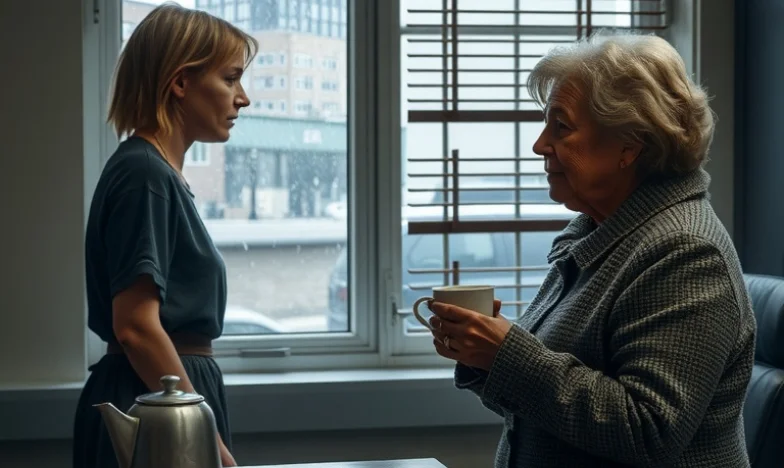
One rainy Thursday, as the wind rattled the windows and Jenkins was in one of his black moods, I found myself alone in the break room with Trick. She was staring out at the grey sky, her hands wrapped around a chipped mug. I hesitated, then blurted out, “How do you do it? Stay so calm, I mean. Doesn’t he ever get to you?”
She turned, her eyes crinkling. “Oh, love, he gets to everyone. But I’ve learned not to let it stick. Life’s too short to let other people’s storms drown you.”
I nodded, but something in her tone made me curious. “You’ve been here a long time, haven’t you?”
She laughed, a low, warm sound. “Long enough to know where the bodies are buried. And which skeletons are best left in the cupboard.”
Before I could ask more, Jenkins stormed in, demanding his files. The moment was lost, but the seed of curiosity had been planted.
That evening, as I packed up to leave, I overheard Barry and Fatima whispering near the lifts. “Did you hear about Trick’s son?” Barry murmured. “Back again, apparently. Causing trouble.”
Fatima tutted. “Poor woman. She never talks about him, does she? After what happened…”
Their voices faded as the lift doors closed, but I couldn’t shake the feeling that there was more to Trick than met the eye.
The next day, the office buzzed with gossip. Trick’s son, Daniel, had been seen outside the building, shouting for his mother. Security had escorted him away, but not before he’d made a scene. Jenkins was furious, muttering about ‘family dramas’ and ‘unprofessional behaviour’. Trick arrived late, her face pale but composed. She ignored the stares, sat at her desk, and got on with her work.
At lunch, I found her in the park across the road, feeding the pigeons. I hesitated, then sat beside her. “Are you alright?”
She sighed, her shoulders slumping. “He’s not well, my Daniel. Never has been, really. Got in with the wrong crowd when he was young. Drugs, trouble with the police. I tried to help, but…” She trailed off, wiping her eyes. “People think I should be ashamed. But he’s my son. I can’t just give up on him.”
I reached out, squeezing her hand. “You shouldn’t have to go through this alone.”
She smiled, a sad, grateful smile. “Thank you, Emily. Most people just look away.”
After that, I saw Trick differently. I noticed the way she checked her phone every hour, the way she flinched at loud noises. I started bringing her tea, leaving little notes on her desk. She responded in kind, teaching me the tricks of office survival—how to dodge Jenkins’ rages, how to fix the printer when it jammed, how to find the best biscuits in the supply cupboard.
But the tension in the office grew. Jenkins became more irritable, snapping at everyone. Rumours spread that the company was downsizing. People whispered about redundancies, about who would be next. I worried constantly—about my job, about Trick, about the future.
One Friday afternoon, as the rain hammered the windows and the office emptied out, Jenkins called me into his office. He was pacing, his face red. “Emily, I need you to keep an eye on Mrs Trickett. She’s been distracted lately. We can’t afford mistakes right now.”
I bristled. “She’s going through a lot. Maybe we could cut her some slack?”
He glared at me. “This is a business, not a charity. If she can’t do her job, she’ll have to go.”
I left, furious. That night, I called my mum, pouring out the whole story. She listened, then said quietly, “Sometimes, love, the hardest thing is standing up for someone when it costs you something.”
The next week was a blur. Daniel showed up again, this time in the lobby, shouting for his mother. Security called the police. Trick was called into HR. The office buzzed with speculation. Jenkins was livid, demanding her resignation.
I couldn’t stand it. At lunch, I stood up in the break room, my voice shaking. “This isn’t right. Trick’s done more for this place than any of us. She’s always there when we need her. Maybe it’s time we were there for her.”
There was a stunned silence. Then Barry nodded. “She helped me when my wife was ill.” Fatima added, “She covered for me when I had to leave early for my kids.” One by one, people spoke up, sharing stories of Trick’s quiet kindness.
The next day, we presented a petition to HR, demanding that Trick be supported, not punished. Jenkins was furious, but HR relented. Trick was given time off, counselling, and a promise that her job was safe.
When she returned, she hugged me, tears in her eyes. “You didn’t have to do that.”
I smiled. “You’d have done the same for me.”
Life didn’t magically get easier. Daniel still struggled, Jenkins was still a nightmare, the company still threatened redundancies. But something had shifted. People talked more, helped each other more. The office felt less like a battlefield, more like a community.
Sometimes, when the light slants through the window just right, I see Trick at her desk, humming softly, and I remember that even in the darkest places, a little kindness can break through like sunlight.
I often wonder—if we all stood up for each other a bit more, would the world be a kinder place? Or are we all just waiting for someone else to make the first move?