When My Mother-in-Law Pulled the Chair Away: A Night That Changed Everything

“Don’t you dare sit there, Anna!” Maureen’s voice sliced through the laughter and clinking glasses, sharp as the edge of a broken wine bottle. I froze, halfway to the empty chair at the head of the table, my hands instinctively cradling my swollen belly. The room fell silent, every eye turning to me, then to her. My cheeks burned. I could feel the baby kick, startled by the sudden tension.
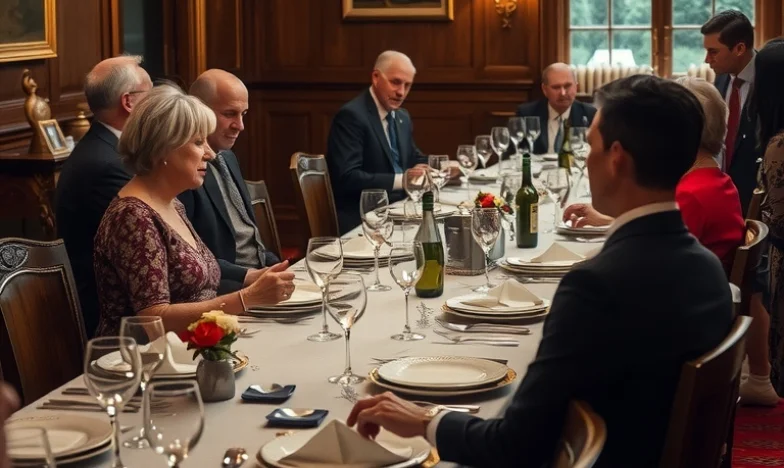
It was supposed to be a celebration. Tomasz—Tom, as everyone called him now—had just been made regional director at the firm. The house was filled with the scent of roast beef and expensive perfume, the crystal chandeliers scattering light across the polished oak floor. Our family, the Kowalskis, had never looked more perfect. But beneath the surface, cracks had been spreading for years, and tonight, they finally split wide open.
Maureen, my mother-in-law, sat at the head of the table, her silver hair coiffed into a helmet, her lips pursed in perpetual disapproval. She’d never liked me. I was too quiet, too plain, too… Polish, she’d once whispered to Tom when she thought I couldn’t hear. But I’d tried. God, I’d tried. I’d learned to make Yorkshire pudding, laughed at her jokes, even let her redecorate our nursery in shades of beige she insisted were ‘classy’. Nothing was ever enough.
I glanced at Tom, hoping for support. He looked away, fiddling with his cufflinks, his jaw clenched. The guests—his colleagues, their wives, his cousins—shifted uncomfortably, unsure whether to intervene or pretend nothing was happening. Only Maureen’s sister, Auntie Jean, dared to speak. “Oh, let the poor girl sit, Maureen. She’s eight months gone!”
Maureen’s eyes narrowed. “She’ll sit where I say. This is my house, my table.”
I felt the sting of tears, but I refused to let them fall. Not here. Not in front of her. I took a shaky breath and reached for the chair again. That’s when she did it. With a swift, deliberate movement, Maureen yanked the chair away. My knees buckled. For a split second, I hovered between standing and falling, the world tilting. Then I crashed to the floor, the pain shooting up my side, my scream echoing off the chandelier.
Chaos erupted. Tom rushed to my side, his face ashen. “Anna! Are you alright? Anna, talk to me!”
I couldn’t speak. The shock, the humiliation, the fear for my baby—all of it tangled in my throat. Someone called for an ambulance. Maureen stood over me, her face unreadable. “If you’d listened, this wouldn’t have happened,” she muttered, but her voice trembled.
The paramedics arrived quickly. As they lifted me onto the stretcher, I caught a glimpse of Tom, torn between his mother and me. I saw the question in his eyes: Why did you have to make a scene?
The hospital was a blur of bright lights and hushed voices. The baby was fine, thank God, but I was kept overnight for observation. Tom stayed with me, but he was distant, his phone buzzing with messages from his mother. I wanted him to hold me, to tell me he was on my side, but all he said was, “You know how she gets. Maybe you could’ve just let it go.”
Let it go. As if I hadn’t been letting it go for years. The snide remarks about my accent, the constant criticism of my cooking, the way she’d rearrange my cupboards when she thought I wasn’t looking. The time she told Tom, “You could’ve married an English girl, someone who understands our ways.”
I lay awake that night, staring at the ceiling tiles, wondering how I’d ended up here. I’d come to England for love, leaving behind my family, my language, everything I knew. I’d thought I could build a new life, that Tom and I could be happy. But Maureen had made it clear from the start: I was an outsider. And Tom, for all his promises, never truly stood up for me.
The next morning, Tom drove me home in silence. The house was spotless, the remnants of the party erased as if it had never happened. Maureen was in the kitchen, making tea. She didn’t look up as we entered. “You’re back, then,” she said, her voice flat.
I wanted to scream, to throw something, to make her feel the pain she’d caused. But I just stood there, numb. Tom cleared his throat. “Mum, we need to talk.”
She turned, her eyes cold. “About what? Anna’s little performance? She’s always been dramatic.”
I snapped. “I’m not dramatic. I’m pregnant. And you pulled the chair away on purpose.”
Her lips curled into a sneer. “Maybe if you had a bit more backbone, you wouldn’t be so easy to knock over.”
Tom stepped between us. “Mum, that’s enough. You went too far.”
For the first time, I saw fear flicker in her eyes. But it was gone in an instant, replaced by anger. “You’re choosing her over your own mother?”
Tom hesitated. “I’m choosing what’s right.”
She laughed, a harsh, brittle sound. “You’ll regret it. Blood is thicker than water, Tomasz.”
He flinched at the use of his full name, the one he’d tried to leave behind. I reached for his hand, but he pulled away. “I need some air,” he muttered, and left the room.
I stood alone with Maureen, the silence between us heavy as lead. She poured herself a cup of tea, her hands shaking. “You think you’ve won, don’t you?”
I shook my head. “There’s nothing to win. I just want to be treated with respect.”
She snorted. “Respect is earned, Anna. And you haven’t earned mine.”
I left the kitchen, my heart pounding. Upstairs, I sat on the edge of the bed, staring at the nursery Maureen had decorated. Beige walls, beige curtains, beige cot. It felt like a mausoleum, not a place for a child. I realised then that I couldn’t raise my baby in this house, under her shadow.
When Tom returned, I told him. “I can’t stay here. Not with her. Not after what she did.”
He looked torn. “She’s my mum. She’s all I’ve got.”
“And I’m your wife. I’m carrying your child. Doesn’t that matter?”
He sat beside me, his head in his hands. “I don’t know what to do, Anna. She’s always been like this. I thought she’d change.”
“She won’t. And if you can’t stand up to her, then I have to leave.”
He looked at me, his eyes full of pain. “Where will you go?”
“I’ll find somewhere. I have friends. I can’t let our child grow up thinking this is normal.”
He didn’t try to stop me. That hurt more than anything. I packed a bag, called a taxi, and left. As the car pulled away, I looked back at the house, its windows glowing in the dusk. I wondered if Tom would come after me, if he’d finally choose me over her. But he didn’t.
I moved in with my friend Sarah, who welcomed me with open arms. She listened as I cried, made me tea, and helped me find a new flat. The baby was born a month later, a little girl with Tom’s eyes and my smile. I sent him a photo. He replied, “She’s beautiful. I’m sorry.”
Maureen never reached out. I heard from mutual friends that she told everyone I’d run off, that I was unstable, ungrateful. But I didn’t care. I had my daughter, my freedom, and the knowledge that I’d finally stood up for myself.
Sometimes, late at night, I wonder if I did the right thing. If I should have tried harder, forgiven more. But then I remember the look in Maureen’s eyes as she pulled that chair away, the way Tom hesitated, the silence that followed. I know I couldn’t have stayed. Not for him, not for anyone.
Do we owe our families endless forgiveness, even when they hurt us? Or is there a point where we have to choose ourselves, no matter the cost?