You Have No Home, and I Have No Mum: A Winter’s Encounter at the Bus Stop

“You don’t have a home, and I don’t have a mum.”
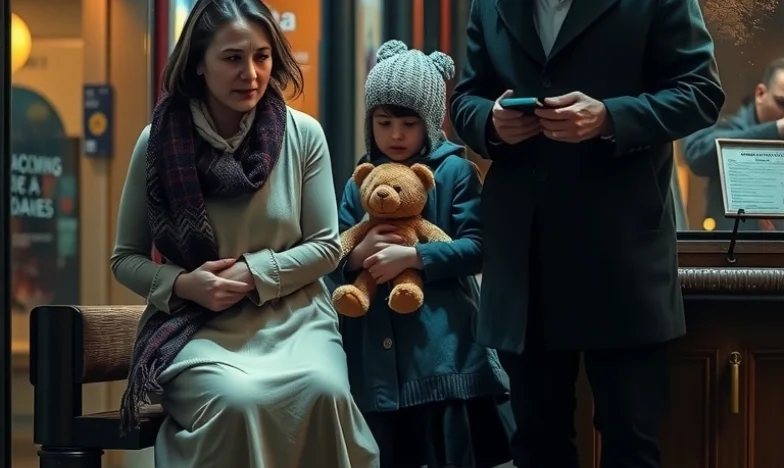
The words hung in the air, sharp as the wind that whipped along the high street. I blinked, trying to focus through the blur of tears and sleet. My feet were bare, pressed against the slushy pavement, and the thin beige dress I’d worn to the office Christmas dinner clung to my skin, offering little warmth. I’d left the party early, unable to bear the forced laughter and clinking glasses, and now I was here, at the bus stop outside King’s Cross, with nowhere to go.
The little girl stood beside me, her cheeks flushed pink beneath a woolly hat, her gloved hand clutching a battered teddy. Her father, a tall man with tired eyes, was fumbling with his phone, oblivious to the exchange. I tried to smile, but my lips trembled.
“Where’s your mum?” I asked softly, my voice barely audible above the traffic.
She looked down, scuffing her boots against the kerb. “She died last year. Daddy says she’s in heaven, but I don’t know where that is.”
I swallowed hard. “I’m sorry.”
She shrugged, as if sorrow was a coat she’d grown used to wearing. “Are you cold?”
I nodded. “A bit.”
She tugged at her father’s sleeve. “Daddy, can we give her my scarf?”
He glanced at me, his gaze flickering over my bare feet, the dress, the way I hugged myself against the cold. Embarrassment flushed my cheeks. I wanted to disappear, to melt into the puddles at my feet.
“Thank you, love, but she might be waiting for someone,” he said, his voice gentle but wary. He looked at me, and I saw the calculation in his eyes—the silent assessment of risk, the unspoken fear that comes with living in a city where kindness can be dangerous.
“I’m not waiting for anyone,” I said, surprising myself. “I just… needed somewhere to sit.”
He hesitated, then nodded. “Would you like a cup of tea? There’s a café just there.”
I shook my head. “I don’t have any money.”
He smiled, a tired, sympathetic smile. “It’s Christmas. My treat.”
The girl beamed, and for a moment, I saw a flicker of hope in her eyes. We walked together to the café, the warmth inside hitting me like a wave. I sank into a chair, my feet tingling as they thawed. The man ordered tea and hot chocolate, and the girl sat beside me, swinging her legs.
“What’s your name?” she asked.
“Isabel.”
“I’m Sophie. This is Mr. Bear.” She held up her teddy, its fur matted and one eye missing.
“Nice to meet you, Mr. Bear,” I said, managing a weak smile.
Sophie giggled, and for a moment, the heaviness in my chest eased. But then I caught my reflection in the window—the dark circles under my eyes, the tangled hair, the haunted look I couldn’t shake. I looked like someone who’d lost everything.
The tea arrived, steaming and fragrant. I wrapped my hands around the mug, savouring the heat. Sophie sipped her hot chocolate, leaving a moustache of foam on her upper lip.
“Why don’t you have a home?” she asked, her voice innocent, unfiltered.
Her father started to apologise, but I shook my head. “It’s all right. I… I lost my job last month. Couldn’t pay the rent. My family—well, we don’t really talk anymore.”
Sophie frowned. “Why not?”
I hesitated, the words catching in my throat. “Sometimes families fight. Sometimes they say things they can’t take back.”
She nodded, as if she understood more than a child should. “Daddy and Grandma fight a lot. She says he should have tried harder to save Mummy.”
Her father stiffened, his jaw clenched. I looked away, ashamed for intruding on their pain.
We sat in silence for a while, the café bustling around us. I watched the other customers—couples laughing, friends exchanging gifts, families gathered around tables. I felt invisible, a ghost haunting the edges of their joy.
Sophie broke the silence. “Do you miss your mum?”
I nodded, tears prickling my eyes. “Every day.”
She reached across the table, her small hand covering mine. “Me too.”
Her father cleared his throat. “We should be going, Sophie. The bus will be here soon.”
Sophie looked at me, her eyes wide and earnest. “Will you be okay?”
I forced a smile. “I’ll manage.”
She hesitated, then slipped her scarf from around her neck and handed it to me. “You need it more than me.”
I tried to refuse, but she insisted, her grip surprisingly strong. “Please. Mummy knitted it. She’d want you to have it.”
I took the scarf, pressing it to my face. It smelled of lavender and childhood. “Thank you, Sophie. I’ll take good care of it.”
They left, the bell above the door jingling as they stepped into the night. I watched them go, the little girl waving until she disappeared from view.
I sat there long after they’d gone, the scarf wrapped around my neck, the warmth of their kindness lingering. I thought about my own mother—how we’d fought before she died, the words I’d never get to take back. I thought about the family I’d lost, the home that was no longer mine, the future that seemed as bleak as the winter sky.
But for a moment, in that café, I’d felt seen. I’d felt human.
The days that followed were a blur of cold and hunger. I slept in doorways, queued at soup kitchens, avoided the eyes of strangers. But I kept Sophie’s scarf with me, a talisman against the darkness.
One evening, as I huddled beneath an awning, a woman approached me. She was older, her hair streaked with grey, her coat expensive. She hesitated, then knelt beside me.
“Are you Isabel?”
I stared at her, confused. “Yes?”
She smiled. “My granddaughter told me about you. Sophie. She said you needed help.”
I blinked, hope flickering in my chest. “She did?”
She nodded. “Come with me. We’ll get you warm, get you fed. No one should be alone at Christmas.”
I followed her, my heart pounding. She led me to her home—a cosy flat filled with photos and laughter. She made me tea, gave me a hot bath, let me sleep in a real bed for the first time in weeks.
Over the next few days, she helped me find a shelter, connected me with a charity that offered job training. She listened to my story without judgement, offered advice without pity.
Slowly, I began to rebuild. I found work at a local bakery, saved enough for a small bedsit. I wrote letters to my family, apologising for the things I’d said, the bridges I’d burned. Some replied, others didn’t. But I kept trying.
Every Christmas, I visit Sophie and her family. We share tea and laughter, exchange small gifts. I still wear the scarf her mother knitted, a reminder of the night a little girl’s kindness changed my life.
Sometimes, when the nights are long and the world feels cold, I remember Sophie’s words: “You don’t have a home, and I don’t have a mum.”
We were both missing something, both searching for a place to belong. Maybe that’s what binds us all—the things we’ve lost, the hope that someone, somewhere, will see us, and care.
I wonder, do we ever truly find home again after loss? Or do we simply build new ones, brick by fragile brick, with the kindness of strangers and the courage to keep going? What do you think—can a single act of compassion really change a life?