I Don’t Love My Own Grandson: A British Grandfather’s Confession

“You’re not even trying, Dad!” My daughter’s voice cut through the Sunday quiet, sharp as the wind that rattled the windowpanes of my terraced house in Sheffield. I stood in the kitchen, hands trembling over the kettle, watching the steam curl upwards as if it might carry my guilt away. In the living room, little Jamie’s laughter rang out, high and bright, but it felt like a foreign sound to me—a language I’d never learned.
I’ve never written anything like this before, but today, I need to put it down. Maybe if I see the words, I’ll understand myself. Maybe someone out there will understand me, too. My name is Arthur Bennett, I’m sixty-five, and I am ashamed to admit that I do not love my own grandson. I want to, God knows I do. But every time I look at Jamie, I feel nothing but a hollow ache, as if something vital has gone missing inside me.
It wasn’t always like this. When my daughter, Emily, told me she was pregnant, I felt the expected surge of pride. I bought a bottle of whisky, toasted her with my mates at the pub, and even knitted a tiny blue hat for the baby. But when Jamie arrived—red-faced, squalling, utterly dependent—I felt only a cold detachment. I told myself it was nerves, that the love would come. It never did.
Emily noticed, of course. She’s always been sharp, my girl. “Dad, do you want to hold him?” she’d ask, thrusting Jamie into my arms. I’d cradle him awkwardly, terrified he’d start crying, and pray for the moment to end. “You’re stiff as a board,” she’d say, half-joking, but her eyes searched my face for something I couldn’t give.
The months passed, and Jamie grew. He learned to crawl, then to walk, his chubby hands reaching for everything. Emily and her husband, Tom, would visit every Sunday, filling my house with noise and chaos. I’d sit in my armchair, newspaper in hand, pretending to read while Jamie built towers of blocks at my feet. Sometimes he’d look up at me, blue eyes wide, and I’d force a smile, hoping it looked real.
One afternoon, Emily cornered me in the kitchen. “Dad, what’s going on?” she demanded, her voice trembling. “You barely speak to Jamie. You never play with him. He’s your grandson!”
I stared at the floor, shame burning in my cheeks. “I’m sorry, love. I just… I don’t know what to do with him.”
She shook her head, tears brimming in her eyes. “He adores you, Dad. He talks about you all the time. Why can’t you just try?”
I wanted to tell her the truth—that every time I looked at Jamie, I saw my own failures as a father. That I remembered all the times I’d shouted at Emily, missed her school plays, buried myself in work to avoid the messiness of family life. That Jamie’s innocence made me feel unworthy, as if I’d already wasted my chance at love.
But I couldn’t say any of that. Instead, I mumbled something about being tired, about getting older, about how children had never been my strong suit. Emily left the kitchen in silence, and I heard her crying in the hallway. Jamie’s laughter, once again, seemed to mock me.
The weeks blurred together. I tried to make an effort—bought Jamie a toy train, took him to the park once or twice—but it always felt forced, like I was playing a part in someone else’s play. Tom, ever the peacemaker, would clap me on the back and say, “You’re doing great, Arthur,” but I could see the doubt in his eyes.
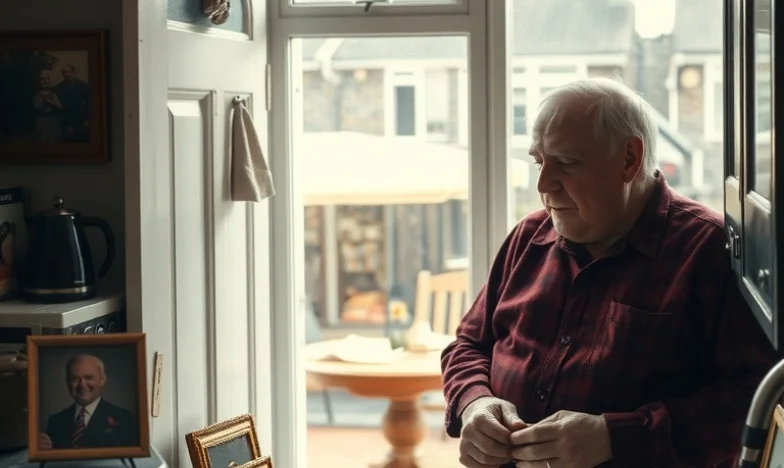
One evening, after Emily and Tom had gone home, I sat alone in the dark, the house echoing with silence. I poured myself a whisky and stared at the family photos on the mantelpiece. There was Emily, aged six, grinning in her school uniform. There was my late wife, Margaret, her arm around me, eyes crinkled with laughter. And there, in the newest frame, was Jamie—smiling, oblivious, his whole life ahead of him.
I thought about Margaret then, about how she’d have loved Jamie. She’d have scooped him up, sung him silly songs, baked him biscuits. She’d have known what to do. Without her, I felt adrift, a ship without a rudder. I missed her more than ever, and the ache of her absence mingled with my guilt over Jamie.
The next Sunday, Emily arrived alone. She looked tired, her face drawn. “Tom’s taken Jamie to his mum’s,” she said, avoiding my gaze. “I thought we should talk.”
I braced myself, heart pounding. “Emily, I’m sorry. I know I’m not the grandfather you wanted.”
She sat across from me, hands clenched in her lap. “I just don’t understand, Dad. You were never like this with me. You used to make up stories, take me to the seaside, teach me how to ride my bike. What’s changed?”
I swallowed hard. “I don’t know. Maybe I’m scared. Maybe I don’t know how to love anymore.”
She reached across the table, her hand warm on mine. “It’s not too late, Dad. Jamie just wants you to try. I want you to try.”
Her words broke something in me. I started to cry—silent, wracking sobs that shook my whole body. Emily held my hand, her own tears falling. For the first time, I admitted the truth: “I’m afraid I’ll let him down. Like I let you down.”
She squeezed my hand. “You didn’t let me down, Dad. You did your best. That’s all Jamie needs, too.”
After that day, I tried harder. I started small—reading Jamie a story, letting him help me in the garden, showing him how to feed the birds. It was awkward at first, but slowly, something shifted. Jamie would climb onto my lap, chattering about dinosaurs and rockets, and I’d listen, really listen. Sometimes, I even found myself smiling for real.
But the warmth I longed for—the easy, unconditional love I saw in other grandparents—still eluded me. I worried there was something broken inside me, something that couldn’t be fixed. I envied the old men in the park, their grandchildren clinging to their hands, laughter coming easy as breathing.
One rainy afternoon, Jamie and I sat by the window, watching the drops race down the glass. “Grandad, do you love me?” he asked, his voice small.
The question hit me like a punch. I hesitated, searching for the right words. “I’m trying, Jamie. I really am.”
He nodded, as if that was enough. He leaned against me, warm and trusting, and for a moment, I felt a flicker of something—hope, maybe, or the beginnings of love.
Now, as I write this, I wonder if love is something you can learn, or if it’s just meant to be. I wonder if other grandparents feel the same shame, the same fear of not measuring up. I wonder if, one day, I’ll wake up and find that the stone in my chest has melted away.
Do you think it’s possible to learn to love, even when it doesn’t come naturally? Or am I doomed to carry this weight forever? I’d give anything to feel the warmth I see in others—anything at all.