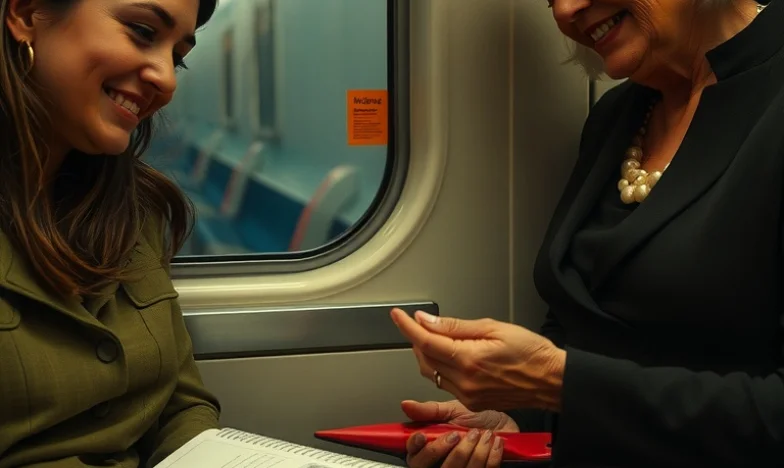
Reflections in the Underground

The doors hissed shut behind me as I collapsed onto the nearest seat, my feet throbbing in the ridiculous heels I’d chosen for tonight’s exhibition. Why did I bother? I could almost hear my mother’s voice in my head: “Alicia, a woman should never let herself go, no matter her age.” I glanced at my reflection in the window, the city lights flickering behind me, and tried to convince myself I looked presentable. Not bad, really, for forty-eight and running on three hours’ sleep. If you don’t count the crow’s feet, the tired eyes, the way my lipstick always seems to bleed into the lines around my mouth.
A group of teenagers boarded at Camden Town, their laughter echoing through the carriage. One of them, a girl with a shock of blue hair, caught my eye and grinned. I smiled back, remembering when I’d been that age, fearless and full of dreams. Now, I felt like I was clinging to the remnants of my own ambition, painting canvases no one seemed to want, attending openings where people sipped cheap wine and talked more about house prices than art.
My phone buzzed. A message from my daughter, Emily: “Mum, are you coming home soon? Dad’s being impossible.” I sighed. Mark and I had been at each other’s throats for months, ever since he’d lost his job at the bank. He’d started drinking more, snapping at Emily, blaming me for everything from the bills to the weather. I’d tried to keep the peace, but it was like painting over damp – the cracks always showed through.
I typed a quick reply: “On my way. Tell him to leave you alone.”
The train lurched, and I clutched my bag tighter. Inside was my sketchbook, filled with half-finished ideas, and a letter from the gallery – another polite rejection. “Your work is interesting, but not quite what we’re looking for at this time.” I’d read it so many times I could recite it by heart. I wondered if I should just give up, get a proper job, something with a pension and sick pay. But then what would be left of me?
At Euston, a man in a suit sat opposite me, his eyes glued to his phone. I imagined his life: a wife, two kids, a mortgage in the suburbs. Did he ever feel like he was drowning? Did he ever wake up in the middle of the night, heart racing, wondering where it had all gone wrong?
The train rattled on, and I drifted back to the opening tonight. My painting, “Woman in Red,” hung in the corner, ignored by most. A couple of people had stopped to look, murmured something about the brushwork, then moved on. I’d stood there, glass in hand, pretending not to care. But I did care. I cared so much it hurt.
“Excuse me, is this seat taken?”
I looked up. An elderly woman, her hair perfectly coiffed, smiled at me. “No, please,” I said, moving my bag.
She sat down with a sigh. “Long day?”
I nodded. “You could say that.”
She glanced at my shoes. “Those look painful.”
I laughed, surprising myself. “They are. But, you know, a woman’s got to keep up appearances.”
She nodded sagely. “My late husband used to say, ‘You can’t pour from an empty cup.’ Took me years to realise what he meant.”
I smiled, but her words stung. My cup felt bone dry.
The train screeched into King’s Cross. The teenagers tumbled out, replaced by a group of tourists, maps in hand. The city never slept, and neither did my worries.
My phone buzzed again. This time it was Mark: “Where the hell are you? Emily’s being a brat.”
I clenched my jaw, resisting the urge to throw my phone across the carriage. Instead, I typed: “I’ll be home soon. Please don’t shout at her.”
The elderly woman patted my hand. “You look like you could use a friend.”
I blinked back tears. “It’s just… everything feels so hard lately. My husband lost his job, my daughter’s struggling at school, and my art… well, no one seems to care.”
She squeezed my hand. “You care. That’s what matters. The rest will come.”
I wanted to believe her. I really did.
At Angel, she stood up. “Take care, dear. And remember – heels are optional.”
I watched her go, feeling oddly lighter. Maybe I could take her advice. Maybe I could start by taking off these bloody shoes.
The train emptied out as we headed north. I closed my eyes, letting the rhythm lull me. Memories drifted in: painting in my tiny flat in Hackney, Emily as a baby, Mark before the bitterness set in. Where had we lost ourselves?
When I got home, the flat was silent. Emily was in her room, headphones on, eyes red from crying. Mark sat in the kitchen, a half-empty bottle of whisky in front of him.
“Nice of you to show up,” he muttered.
I ignored him, heading straight for Emily’s room. She looked up as I entered, her face crumpling. “Mum, I can’t do this anymore. He’s so angry all the time.”
I hugged her tightly. “I know, love. I know.”
Down the hall, I heard Mark slam a cupboard. I steeled myself and went to face him.
“We can’t keep going like this, Mark.”
He glared at me. “What do you want me to do? I’m trying!”
“Are you? Because all I see is you taking it out on us.”
He looked away, jaw clenched. “I’m sorry. I just… I don’t know who I am anymore.”
Neither did I. But I couldn’t say that. Not now.
That night, after everyone had gone to bed, I sat at the kitchen table, sketchbook open. I drew until my hand cramped, pouring all my fear and frustration onto the page. When I finished, I looked at the mess of lines and colours and felt, for the first time in months, a flicker of hope.
The next morning, I left my heels by the door and walked Emily to school in trainers. She squeezed my hand, and I squeezed back. Maybe things weren’t perfect. Maybe they never would be. But I was still here. Still fighting.
As I watched her disappear through the school gates, I wondered: When did we start believing we had to have it all together? And what would happen if we finally let ourselves fall apart?