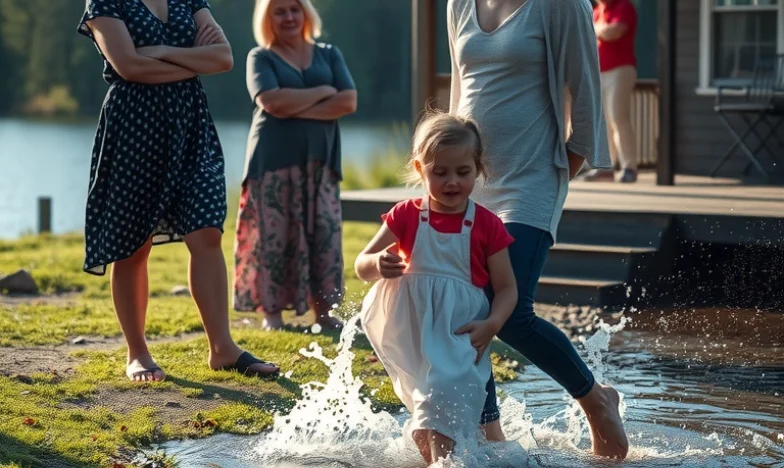
Ripples on the Water: A Family Fracture at the Lake

‘Mummy, can I go play with Sophie?’ My daughter’s small hand tugged at my sleeve, her blue eyes wide with hope and a hint of nerves. The sun was barely peeking through the clouds, dappling the old wooden porch with shifting patterns, and the air was thick with the scent of pine and the distant sizzle of sausages on the barbecue. I glanced over at Sophie, my sister’s daughter, already skipping stones by the water’s edge, her laughter ringing out like a bell.
I hesitated, the memory of last year’s scraped knees and tears still fresh. ‘Stay where I can see you, darling,’ I said, but before I could finish, my mother’s voice cut in, sharp and dismissive. ‘Oh, let them be, Anna. They’re children, not porcelain dolls. You worry too much.’ My father, already two pints in, nodded in agreement, waving his hand as if to brush away my concerns.
I tried to swallow my unease, but it stuck in my throat like a stone. ‘Just… don’t go near the deep end, all right?’ I called after them, but my words were lost in the wind and the chatter of cousins reuniting. I turned back to the table, arranging paper plates and plastic cups, forcing myself to join in the small talk, but my eyes kept drifting to the lake, to the two little figures darting along the shore.
Minutes passed—ten, maybe fifteen. The laughter grew louder, then suddenly, it was pierced by a splash, sharp and wrong. My heart stopped. I dropped the cutlery and ran, feet pounding over the grass, voices behind me blurring into a single, rising note of panic.
My daughter was in the water, her arms flailing, her mouth open in a silent scream. I didn’t think, I just jumped in, the cold biting through my clothes as I grabbed her, pulling her to the surface. She clung to me, sobbing, her tiny body shaking. ‘She pushed me, Mummy. Sophie pushed me.’
I carried her out, dripping and breathless, my own heart hammering in my chest. My mother was there in an instant, her face twisted with concern—then annoyance. ‘What happened now?’ she demanded, glancing at Sophie, who stood on the shore, arms folded, chin jutting out in defiance.
‘She pushed her,’ I said, my voice trembling with anger and fear. ‘Sophie pushed Emily into the lake.’
My sister, Claire, appeared, her face flushed. ‘Don’t be ridiculous, Anna. They were playing. Sophie wouldn’t—’
‘She did!’ Emily cried, her voice breaking. ‘She said I was a baby and pushed me.’
My mother’s eyes narrowed. ‘That’s enough. Sophie would never do such a thing. Emily’s always been dramatic. You’re making a scene, Anna.’
I stared at her, stunned. ‘She could have drowned, Mum. She can’t swim yet. You know that.’
‘Don’t you dare accuse my granddaughter,’ my mother snapped, stepping between me and Claire. ‘You’re always looking for someone to blame. Maybe if you weren’t so overprotective—’
The words stung, but what came next was worse. My mother’s hand flashed out, sharp and sudden, catching me across the cheek. The sound echoed, louder than the splash, louder than the shouts. For a moment, everything stopped. My face burned, not just from the slap but from the humiliation, the betrayal.
I looked at Claire, but she just looked away, her lips pressed into a thin line. Sophie was crying now, but no one seemed to notice. My father muttered something about ‘women’s drama’ and wandered back to his beer. The rest of the family stood frozen, eyes darting between us, unsure whether to intervene or pretend nothing had happened.
I held Emily close, her wet hair plastered to her forehead, her sobs quieting into hiccups. I wanted to scream, to shout, to demand someone—anyone—stand up for us. But the words stuck. I turned away, carrying Emily back to the house, my mother’s voice following me, sharp and cold. ‘Don’t ruin this for everyone, Anna. It’s just a bit of water.’
Inside, I wrapped Emily in a towel, my hands shaking. She looked up at me, her eyes red and swollen. ‘Why did Sophie do that, Mummy? Did I do something wrong?’
‘No, sweetheart. You didn’t do anything wrong.’ I tried to keep my voice steady, but the tears were already slipping down my cheeks. ‘Sometimes people do things they shouldn’t. But you’re safe now.’
I sat with her on the bed, listening to the muffled sounds of laughter and music drifting in from outside. I could hear my family, carrying on as if nothing had happened, as if my daughter hadn’t just been pushed into the lake, as if my mother hadn’t just slapped me in front of everyone.
When my husband, Tom, arrived an hour later, I was still sitting there, Emily asleep in my arms. He took one look at my face and his own darkened. ‘What happened?’
I told him everything, the words tumbling out in a rush—Emily in the water, Sophie’s push, my mother’s slap, the silence that followed. He listened, jaw clenched, fists tight at his sides. ‘We’re leaving,’ he said, his voice low and steady. ‘I’m not staying here another minute.’
I wanted to argue, to say we couldn’t just walk out, but I couldn’t find the strength. I packed our things in silence, my hands moving automatically. As we walked out, my mother appeared in the doorway, her expression unreadable. ‘Running away, are you? That’s what you always do, Anna. Never face up to things.’
Tom stepped between us, his voice cold. ‘She’s not running away. She’s protecting her daughter. Something you clearly don’t understand.’
My mother’s lips curled into a sneer. ‘You always did think you were better than us, Anna. Always so sensitive, so dramatic. Maybe if you toughened up, your daughter wouldn’t be such a crybaby.’
I felt the old shame rising, the urge to apologise, to smooth things over, to pretend everything was fine. But Tom’s hand was warm on my back, steadying me. ‘Let’s go,’ he said, and I followed him out, Emily’s small hand in mine.
The drive home was silent, the only sound the hum of the tyres on the tarmac and Emily’s soft breathing in the back seat. I stared out the window, watching the trees blur past, my mind replaying the day over and over. The slap, the splash, the silence. The way my family had closed ranks, protecting Sophie, protecting themselves, leaving me and Emily out in the cold.
That night, after Emily was tucked into bed, Tom sat beside me on the sofa, his arm around my shoulders. ‘You did the right thing,’ he said quietly. ‘You stood up for her. For both of you.’
I wanted to believe him, but the doubt lingered. Had I overreacted? Was I too protective, too sensitive, just like my mother said? Or was I right to demand more, to expect my family to care, to protect, to listen?
Days passed, then weeks. My mother called, once, leaving a terse message. ‘Hope you’re happy. You’ve ruined the family holiday. Sophie’s been in tears. Claire’s furious. You always have to make everything about you.’ I deleted it without replying.
Claire sent a text: ‘Mum’s upset. Sophie says she didn’t mean it. Can we just move on?’
But how do you move on from something like that? How do you forgive a family that refuses to see you, to hear you, to believe you? How do you protect your child when the people you trust most turn their backs?
I started seeing a counsellor, talking through the tangled mess of guilt and anger and grief. I watched Emily, wary now around other children, her laughter quieter, her eyes always searching for me. I tried to rebuild her trust, to show her that not everyone would let her down.
Months later, as autumn crept in and the leaves turned gold, I took Emily back to the lake, just the two of us. We walked along the shore, the water calm and still, the memories lingering but softer now. She held my hand, her grip tight but steady.
‘Are we safe, Mummy?’ she asked, her voice small.
‘Yes, darling. We’re safe.’
I looked out at the water, the surface unbroken, and wondered if families are like lakes—beautiful on the surface, but hiding currents that can pull you under when you least expect it.
I still don’t know if I did the right thing, if speaking out was worth the cost. But I do know this: silence protects no one. Not really.
Would you have stayed silent? Or would you have spoken up, even if it meant losing the people you thought would always be there for you?