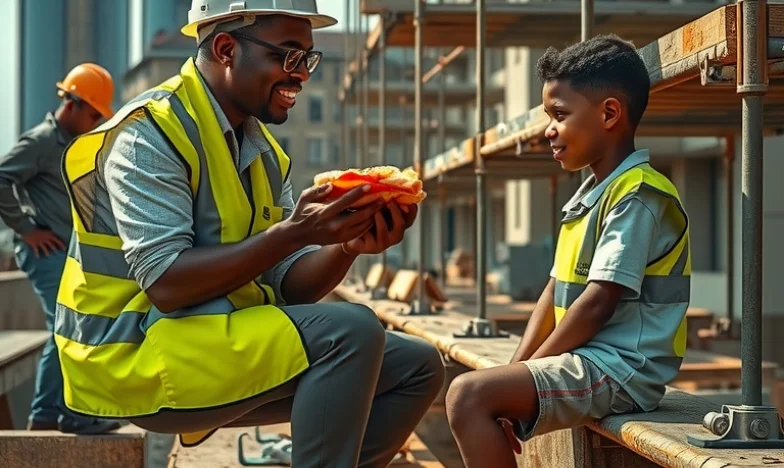
A Builder’s Kindness: The Lunch That Changed Everything

“Oi, mate, you alright?”
The words barely left my lips before I realised the boy wasn’t. He sat on the edge of the scaffolding, knees drawn up, his face streaked with tears and grime. The lunch bell had just rung, and the lads were already tearing into their sandwiches, laughter echoing through the half-built estate in Hackney. But this boy, maybe eight or nine, sat alone, clutching his stomach, his eyes darting between the workers and the food they unwrapped with calloused hands.
I wiped the sweat from my brow, the July sun beating down mercilessly. My own stomach rumbled, but something about the way the boy’s shoulders shook made me forget my hunger. I crouched beside him, the concrete still warm from the morning’s heat.
“Hey, what’s your name?” I asked, trying to sound gentle. He flinched, but didn’t answer. I noticed then the awkward way his left leg twisted, the faded brace peeking out from under his shorts. His trainers were worn, one sole flapping with every nervous tap of his foot.
I reached into my battered lunchbox, pulling out half a cheese and pickle sandwich. “You look like you could use this more than me.”
He eyed the sandwich, suspicion warring with hunger. Finally, he snatched it, devouring it in three bites. I offered the rest of my lunch—an apple, a packet of crisps. He ate in silence, tears still streaming down his cheeks.
“Where’s your mum, lad?” I ventured. He shook his head, mouth too full to answer. I glanced around, but none of the other workers seemed to notice us. They were too busy with their own banter, their own worries.
After he finished, he wiped his mouth with the back of his hand. “Thank you,” he whispered, voice hoarse. “Mum’s at work. She cleans the offices over there.” He pointed to the glass towers looming over our site. “She said to wait here, but I got hungry.”
I nodded, understanding more than I cared to admit. My own mum had worked two jobs after Dad left, and I’d spent more afternoons than I could count waiting outside buildings, stomach growling, watching other kids with packed lunches and clean uniforms.
“What’s your name?” I asked again.
“Jamie,” he replied, quieter this time.
“Well, Jamie, I’m Tom. You can sit with me if you like. No one’ll bother you.”
He nodded, a shy smile flickering across his face. For the rest of lunch, he sat beside me, listening to the men’s stories, the laughter, the swearing. When his mum finally arrived, breathless and apologetic, she thanked me with a tired smile, her eyes lingering on the empty lunchbox.
That should’ve been the end of it. But the next day, Jamie was back. This time, he brought a crumpled drawing—me, in my high-vis vest, handing him a sandwich. He pressed it into my hand, cheeks flushed with pride.
“Made it for you,” he said. “Mum says you’re a good man.”
I laughed, ruffling his hair. “Don’t let the lads hear you say that.”
Days turned into weeks. Jamie became a fixture at the site, always waiting for his mum, always sitting with me at lunch. The other workers started bringing extra snacks, slipping him chocolate bars and bags of crisps. Even gruff old Mick, who never smiled at anyone, saved his best pork pie for Jamie.
One afternoon, as the clouds rolled in and the air turned heavy with the promise of rain, Jamie’s mum approached me. She looked nervous, twisting her hands in her apron.
“Tom, can I ask you something?”
“Course,” I replied, brushing dust from my jeans.
She hesitated. “Jamie’s dad… he left before Jamie was born. I’ve never told him much, but he’s been asking. I don’t know what to say.”
I swallowed, memories of my own father’s absence rising unbidden. “He’s a good kid. He deserves the truth, even if it hurts.”
She nodded, tears shining in her eyes. “Thank you. For everything.”
That night, I couldn’t sleep. I kept thinking about Jamie, about all the kids like him, left behind by fathers who couldn’t—or wouldn’t—stay. I thought about my own son, Ben, who I only saw on weekends, and the ache in his eyes every time I dropped him back at his mum’s flat.
The next day, Jamie didn’t come. Nor the day after. I asked around, but no one had seen him or his mum. Worry gnawed at me, sharper than hunger. On the third day, I walked to the block of flats where I knew they lived. The lift was broken, so I climbed the stairs, heart pounding.
Their door was ajar. Inside, the flat was silent, save for the hum of the fridge. I called out, but no one answered. On the table, I found a letter, addressed to me.
Tom,
Thank you for looking after Jamie. We’ve had to leave. There’s something you need to know. Jamie’s father… he’s not who I said he was. He was a wealthy man, but he never claimed Jamie. I’ve enclosed documents—birth certificate, letters, proof. Jamie is his only heir. I’m scared, Tom. People have been asking questions. Please, if anything happens to us, look after Jamie. Trust no one.
—Sophie
My hands shook as I read the letter. Attached were official papers, a will, even a bank statement with more zeroes than I’d ever seen. My mind raced. Who was this man? Why had Sophie lied? And where were they now?
I barely slept that night, the letter burning a hole in my pocket. The next morning, two men in suits showed up at the site, asking questions about Sophie and Jamie. They flashed badges, but something about them felt off—too slick, too rehearsed.
“Never seen them,” I lied, heart hammering.
They left, but I knew they’d be back. I called my sister, Sarah, who worked at the council. She promised to look into it, but warned me to be careful.
Days passed. I kept the documents hidden, checking the news, scanning the streets for any sign of Jamie or Sophie. My mates noticed I was jumpy, but I couldn’t tell them. Who would believe me—a builder from Hackney, suddenly holding the key to a fortune?
One evening, as I locked up the site, I heard a familiar voice.
“Tom!”
Jamie stood at the gate, clutching a battered rucksack. His face was pale, eyes wide with fear.
“Mum’s gone,” he whispered. “She said to find you.”
I pulled him into a hug, heart breaking. “You’re safe now, Jamie. I promise.”
We went to my flat, locking the door behind us. I made him beans on toast, the only thing I could cook without burning. He ate in silence, eyes never leaving the window.
“What happened, mate?” I asked gently.
He shook his head. “Mum said bad men were looking for us. She told me to run if anything happened.”
I showed him the letter, the documents. He stared at them, not understanding.
“Jamie, your dad… he left you something. Something big. But it means people might want to hurt you to get it.”
He nodded, tears brimming. “I just want my mum.”
I promised I’d find her. I called Sarah, who pulled every string she could. Days turned into weeks. Jamie stayed with me, growing quieter, more withdrawn. I tried to keep life normal—school runs, football in the park, fish and chips on Fridays. But the shadow of the secret hung over us.
One night, there was a knock at the door. I froze, heart in my throat. But it was Sophie—dishevelled, exhausted, but alive.
“I had to make sure you were safe,” she whispered, collapsing into my arms. “They’re gone. For now.”
We sat up all night, talking. She told me everything—the affair with a wealthy businessman, the threats, the fear. She’d hidden Jamie’s inheritance, hoping to keep him safe. But now, with the documents in my hands, she trusted me to help her do what was right.
Together, we went to the authorities. With Sarah’s help, we found a solicitor, someone we could trust. The process was long, painful, but in the end, Jamie’s inheritance was secured. The men who’d threatened them were arrested. Sophie found work in a safer part of the city. Jamie started a new school, his confidence slowly returning.
As for me, I went back to the site, back to the dust and the noise. But I was changed. I’d seen how a single act of kindness could ripple out, changing lives in ways I’d never imagined.
Sometimes, when the sun beats down and my stomach rumbles, I remember that day—the boy with the crooked leg, the sandwich, the secret that changed everything.
I wonder: how many lives could we change if we just stopped to notice the hungry, the lonely, the lost? And what would you do, if you were in my boots?