The Wedding Silence: A Tale of Pride and Prejudice in Yorkshire

‘You can’t possibly expect us to stay after this, Diego!’ Mrs. Whitmore’s voice cut through the laughter and music like a cold wind off the moors. I stood frozen, my hand still entwined with Diego’s, the confetti barely settled in my hair. The reception hall, decked in autumn golds and burgundies, suddenly felt as cold as a churchyard. My mother’s face was pale, her hands trembling as she clutched her handbag. My father, always so proud in his Sunday suit, looked at the floor, his jaw set.
It had all started so beautifully. The sun had risen over our little Yorkshire town, painting the stone cottages in honeyed light. The whole neighbourhood had turned out for our wedding. I could hear Mrs. Patel from the corner shop laughing with old Mr. Thompson, and the children from the estate chasing each other round the green. Diego, my Diego, had come all the way from London, bringing with him a family who spoke in clipped tones and wore their pride like medals.
But then, as the speeches began, someone whispered. I saw Mrs. Whitmore’s lips curl as she leaned in to her husband. ‘Did you know her parents used to work for the council? Refuse collection, no less.’ The words spread like wildfire. I felt the eyes on us, the sudden hush, the way Diego’s sister, Charlotte, looked at me as if I’d tracked mud onto her white carpet.
‘Maria, is it true?’ Diego’s father asked, his voice low but sharp. ‘Your parents… they were binmen?’
I swallowed, my cheeks burning. ‘My dad drove the dustcart for twenty years. Mum helped out on the rounds when things were tight. They worked hard so I could go to university.’
There was a silence, thick and suffocating. Then Mrs. Whitmore stood up, her chair scraping the floor. ‘I’m sorry, but this is not what we expected. We have standards in our family. Diego, come.’
Diego’s hand tightened on mine. ‘Mum, don’t be ridiculous. Maria’s family are good people.’
But the Whitmores were already gathering their things, their friends following like sheep. The room emptied, the laughter dying. My mother wept quietly into her napkin. My father stood, shoulders hunched, staring at the half-eaten cake.
I wanted to scream, to beg them to stay, to tell them that love was more important than pride. But the words stuck in my throat. Instead, I watched as Diego argued with his parents in the car park, his voice rising, his face red with anger and shame.
‘You’re embarrassing yourself, Diego,’ Charlotte hissed. ‘Think of our reputation!’
‘Reputation?’ Diego spat. ‘You’d rather walk out on my wedding than accept Maria’s family? What does that say about us?’
They drove off, tyres crunching on the gravel, leaving a cloud of dust and a silence so deep it hurt my ears.
I stood in the doorway, my wedding dress suddenly too tight, my heart pounding. The neighbours lingered, unsure whether to stay or go. My father cleared his throat. ‘I’ll fetch something from the van. Don’t let this spoil your day, love.’
He left, and I watched him walk down the lane, his back straight, his steps slow. My mother dabbed her eyes. ‘I’m sorry, Maria. We never meant to bring shame on you.’
‘You haven’t,’ I whispered, hugging her. ‘You’ve given me everything.’
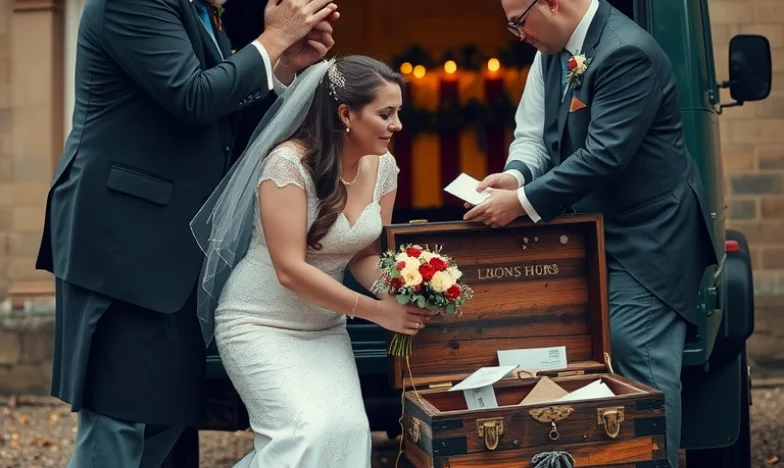
Minutes later, a familiar rumble echoed down the street. Heads turned as the old council dustcart rounded the corner, its green paint faded but still proud. My father climbed out, his cap in his hand, and opened the back. There, among the bags and bins, was a battered old chest.
He carried it into the hall, setting it down with a grunt. ‘This,’ he said, his voice steady, ‘is what we saved for you, Maria. Every penny from every round, every overtime shift, every cold morning. Open it.’
I knelt beside the chest, my hands shaking. Inside were envelopes, each marked with a year, a note from Mum or Dad, and a small stack of cash. ‘For Maria’s future,’ one read. ‘For her dreams.’
Tears blurred my vision. The neighbours crowded round, murmuring in awe. Mrs. Patel squeezed my hand. ‘Your parents are heroes, Maria. Don’t let anyone tell you different.’
Diego returned, his face streaked with tears. He knelt beside me, taking my hand. ‘I’m so sorry. I never realised how much you’ve all sacrificed. My family… they don’t understand. But I do. I love you, Maria. I love your family.’
The room filled with applause, the neighbours rallying round us. My father smiled, his eyes shining. ‘We may not have much, but we have each other. That’s what matters.’
As the sun set over the town, the party resumed. The music played, the children danced, and the dustcart stood outside like a badge of honour. The Whitmores never returned, but I didn’t care. I had my family, my friends, and a husband who finally saw what truly mattered.
Now, years later, I look back on that day with a bittersweet smile. The pain of rejection still stings, but the pride I feel in my parents’ hard work and love is stronger. I wonder, do we ever truly escape the shadows of class and pride in this country? Or is it up to us to break the silence, to stand up and say: this is who we are, and we are enough?