A Room of My Own: The Story of Joanna and the Grey Mouse

“Witam! I’m calling about the room!” The voice on the phone was hesitant, tinged with a foreign accent, and I almost didn’t bother replying. It was already past seven, and the day had been a disaster—my boss had shouted at me for a missed deadline, my mum had left another guilt-tripping voicemail, and the boiler was making that infernal rattling noise again. But something in her voice made me pause. Maybe it was the way she said ‘room’, as if it was the most precious thing in the world.
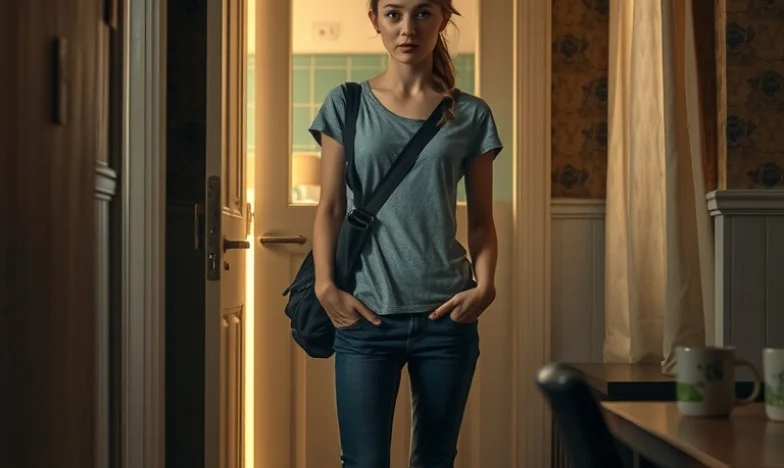
So, when the bell rang, I opened the door and there she was: a real ‘grey mouse’. She wore battered jeans, a faded t-shirt, and trainers that looked like they’d survived a war. Her hair was tied back in a simple ponytail, no makeup, and she clutched a nondescript bag to her chest. But her eyes—huge, blue, and impossibly sad—were what caught me off guard. For a moment, we just stared at each other.
“Joanna?” I asked, trying to sound welcoming, though I was already regretting the ad I’d posted online.
She nodded, her voice barely above a whisper. “Yes. I’m sorry I’m late. The bus was… I got lost.”
I stepped aside, letting her in. The hallway was narrow, the wallpaper peeling in places, and the smell of damp hung in the air. I felt a sudden urge to apologise for the state of the place, but she didn’t seem to notice. She just looked around, wide-eyed, as if she’d stepped into a palace.
We sat at the tiny kitchen table, mugs of tea between us. She told me she was from Poland, here to study at UCL, and that she’d been staying with a distant cousin in Croydon, but it hadn’t worked out. She needed somewhere quiet, somewhere she could focus. I watched her hands tremble as she spoke, the chipped nail polish, the way she kept glancing at the door.
“Why did you leave your cousin’s?” I asked, not unkindly.
She hesitated, then shrugged. “It was… not good. Too many people. Too much noise.”
I nodded, understanding more than I let on. My own flat was my sanctuary, the one place I could escape from the chaos of my family, my job, my own head. Maybe that’s why I said yes, even though I knew my mum would have a fit if she found out I was letting a stranger move in.
The first few weeks were awkward. Joanna kept to herself, barely speaking, always tiptoeing around as if afraid to disturb me. I’d hear her crying sometimes, muffled sobs through the thin walls, but when I asked if she was alright, she’d just smile and say she was tired. I wanted to help, but I didn’t know how. I had my own problems—my mum’s constant calls, my brother’s drinking, the endless pressure at work. I wasn’t sure I had room for someone else’s pain.
One evening, I came home to find her sitting in the dark, staring out the window. The city lights flickered on her face, and for a moment, she looked almost ethereal.
“Joanna?” I said softly. “Are you okay?”
She didn’t answer at first. Then, in a voice so quiet I almost missed it, she said, “Do you ever feel like you don’t belong anywhere?”
The question hit me like a punch to the gut. I sat down beside her, unsure what to say. “All the time,” I admitted. “But I suppose that’s just London, isn’t it? Everyone’s lost here.”
She smiled, a sad, crooked smile. “In Warsaw, I was invisible. Here, I am… nothing.”
I wanted to tell her she wasn’t nothing, that she mattered, but the words stuck in my throat. Instead, I offered her another cup of tea, the British cure for all ills.
As the months passed, we settled into a kind of uneasy truce. She started leaving notes for me—reminders about the milk, apologies for using the last of the bread. I found myself looking forward to her little messages, her shy smiles. We weren’t friends, not really, but there was a comfort in her presence.
Then, one night, everything changed. I came home late, the flat silent and dark. I found Joanna in the bathroom, sitting on the floor, her knees drawn to her chest. There was blood on her wrists, not much, but enough to make my heart stop.
“Oh my God, Joanna!” I dropped to my knees beside her, grabbing a towel, pressing it to her skin. “What have you done?”
She looked at me, her eyes wide with terror. “I’m sorry. I’m so sorry. I just… I can’t do this anymore.”
I called an ambulance, my hands shaking so badly I could barely dial. The paramedics came, efficient and kind, and took her away. I sat on the edge of my bed, numb, the smell of antiseptic lingering in the air.
The next day, I called in sick to work and went to the hospital. She was lying in a stark white bed, her wrists bandaged, her face pale and drawn. She looked up when she saw me, tears spilling down her cheeks.
“I’m sorry,” she whispered. “I didn’t want to be a burden.”
I sat beside her, taking her hand. “You’re not a burden, Joanna. You’re my friend.”
She shook her head. “You don’t even know me.”
“Maybe not,” I said. “But I want to.”
After that, things changed between us. She started talking more, telling me about her life in Poland, her parents’ divorce, the way her mother used to scream at her for hours. She told me about the loneliness, the fear, the nights she spent wandering the city because she couldn’t bear to go home. I listened, really listened, and for the first time in a long time, I felt less alone myself.
My own family was a mess. My mum called every day, demanding to know why I never visited, why I couldn’t be more like my sister, who’d married a banker and moved to Surrey. My brother was in and out of rehab, my dad had disappeared years ago. I’d spent so long pretending everything was fine, but with Joanna, I didn’t have to pretend.
One evening, we sat on the roof, watching the sun set over the city. Joanna turned to me, her eyes shining.
“Do you ever wish you could just start over?” she asked.
“All the time,” I said. “But I think… maybe starting over isn’t about running away. Maybe it’s about finding people who make you feel like you belong.”
She smiled, and for the first time, it reached her eyes.
We became each other’s lifeline. On bad days, we’d sit in silence, sharing a blanket and a bar of chocolate. On good days, we’d laugh until our sides hurt, making up stories about the people we saw on the street below. We learned to navigate each other’s moods, to give space when needed, to offer comfort without judgement.
But life wasn’t a fairy tale. There were setbacks—Joanna struggled with her studies, I lost my job, the rent went up. My mum found out about Joanna and accused me of being irresponsible, of letting ‘strangers’ into my life. We fought, screaming at each other over the phone, old wounds reopening.
“Why can’t you just be normal?” she shouted. “Why do you always have to make things so difficult?”
I hung up, shaking with rage and shame. Joanna found me crying in the kitchen, and for once, she was the one to comfort me.
“You’re not alone,” she said softly. “You have me.”
It wasn’t perfect, but it was enough.
A year later, Joanna graduated. She found a job, moved into her own place, but we stayed close. I found work at a charity, helping other young women who felt lost and alone. My relationship with my family was still complicated, but I was learning to set boundaries, to put myself first.
Sometimes, late at night, I think about that first evening, the girl with the sad eyes and the battered trainers, and I wonder how different things might have been if I hadn’t opened the door. If I’d let fear or prejudice win.
Would I have found the courage to face my own demons? Would I have learned that sometimes, the people who seem the most invisible are the ones who change us the most?
I still don’t have all the answers. But maybe that’s okay. Maybe the point isn’t to have everything figured out, but to keep trying, to keep reaching out, even when it’s hard.
What about you? Have you ever let someone unexpected into your life—and found that they changed you in ways you never imagined? Or are you still waiting for someone to open the door?