Shadows in the Kitchen

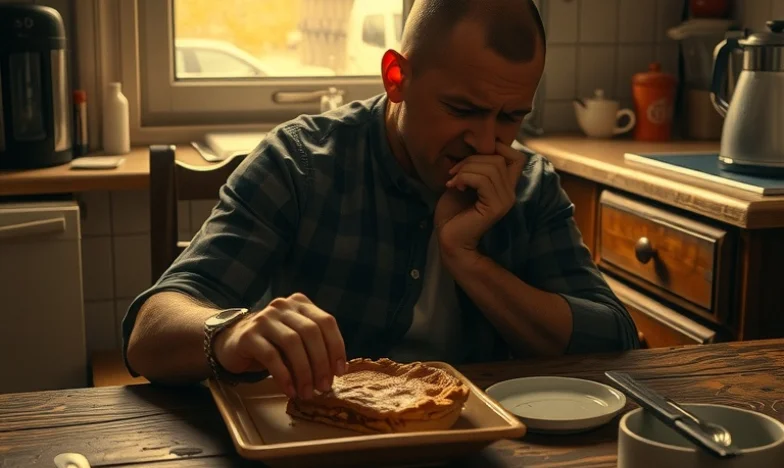
The third time I found a slice of apple pie on my kitchen table, I just stared at it, numb. The crust was golden, dusted with cinnamon, and the scent—warm, familiar—hung in the air like a memory I couldn’t quite grasp. I hadn’t baked it. I hadn’t bought it. I lived alone, in a cramped flat in Hackney, and the only person who ever visited was my sister, but she’d stopped coming round since the last row. I should have been frightened, or at least surprised, but all I felt was that bone-deep exhaustion that had settled in my chest since Mum died last winter.
I slumped into the chair, rubbing my eyes. The city outside was a smear of headlights and drizzle, the kind of London evening that seeps into your bones. I pressed my palms to the table, trying to steady myself. The pie sat there, mocking me with its ordinariness. I thought about calling someone—maybe Anna, my sister—but what would I say? “There’s pie in my kitchen and I don’t know where it’s come from”? She’d just sigh, tell me I was overworked, that I needed to get out more. Maybe she was right. Maybe I was losing it.
The clock on the wall ticked, loud and insistent. I remembered the last time Anna was here, her voice sharp as she accused me of hiding away, of letting the flat turn into a mausoleum. “You can’t just sit here and rot, Chris,” she’d said, her eyes red-rimmed. “Mum wouldn’t have wanted this.” But what did she know? She had her own family, her own life. I was the one left with Mum’s things, her recipes, her ghost lingering in every corner.
I picked up the pie, turning it over in my hands. The pastry was just like Mum used to make—flaky, buttery, with that hint of lemon she always insisted on. My throat tightened. I hadn’t tasted anything like it since the funeral, when Anna and I had tried to bake one together and ended up shouting at each other over the rolling pin. I took a bite, and the taste hit me with a wave of grief so sharp I had to close my eyes.
The next morning, I woke to the sound of the kettle boiling. For a moment, I thought I’d dreamt the whole thing, but when I stumbled into the kitchen, there was another slice of pie on the table. My hands shook as I reached for it. I checked the locks, the windows, even the tiny cupboard where Mum used to hide the Christmas presents. Nothing. No sign of a break-in, no footprints, nothing out of place except the pie.
I called Anna. She answered on the third ring, her voice wary. “Chris? Is everything alright?”
“There’s pie,” I said, stupidly. “In my kitchen. Again.”
She was silent for a moment. “You’re not sleeping, are you?”
“I’m fine,” I lied. “It’s just… it’s Mum’s recipe.”
Anna sighed. “Look, I’ll come round tonight, alright? We’ll talk.”
I spent the day in a fog, drifting through meetings at the office, barely hearing the drone of my colleagues. The city outside was as grey as ever, the Thames swollen with rain. I watched people on the tube, faces blank, eyes fixed on their phones. No one looked at each other anymore. I wondered if anyone would notice if I disappeared.
When I got home, Anna was already waiting on the steps, her coat pulled tight against the wind. She looked tired, older than I remembered. We went inside, and I showed her the pie. She poked at it, sniffed it, then looked at me with something like pity.
“Chris, you need help,” she said quietly. “You’re not coping.”
I bristled. “I’m not mad, Anna. Someone’s been in here.”
She shook her head. “You’re grieving. That’s all. Maybe you made it and forgot.”
I wanted to scream. Instead, I sat down and buried my face in my hands. Anna made tea, bustling around the kitchen like Mum used to. For a moment, I let myself believe she was right, that I’d just forgotten, that the world hadn’t shifted beneath my feet.
But that night, I woke to the sound of footsteps in the kitchen. My heart hammered as I crept down the hallway, the floorboards creaking under my feet. The light was on. I pushed the door open, half-expecting to see Mum standing there, flour on her hands, humming to herself. But the kitchen was empty. The pie was there, steaming gently on the table.
I sank to the floor, shaking. Was I losing my mind? Was this what grief did—made you see things, believe in ghosts? I thought about calling Anna again, but what could she do? She had her own life, her own children to worry about.
The days blurred together. Every morning, a new slice of pie appeared. I stopped going to work. I stopped answering the phone. The city outside faded into a distant hum, and the flat became my whole world. I started talking to Mum, out loud, as if she could hear me. I told her about my day, about Anna, about how lost I felt. Sometimes, I thought I heard her voice, soft and comforting, telling me it would be alright.
One evening, Anna came round unannounced. She found me sitting at the table, staring at the latest slice of pie. She looked at me, really looked, and I saw the fear in her eyes.
“Chris, you need to see someone,” she said, her voice trembling. “This isn’t normal.”
I wanted to argue, to tell her she was wrong, but I couldn’t. I was tired—so tired. I nodded, and she hugged me, her arms tight around my shoulders. For the first time in months, I let myself cry.
Anna made an appointment with a counsellor. I went, reluctantly, sitting in a small, stuffy room while a woman with kind eyes asked me about Mum, about the pie, about the loneliness that had settled over me like a shroud. I told her everything, and she listened, never judging, never interrupting. She told me grief could do strange things, that it could make the past feel more real than the present. She said I wasn’t alone.
Slowly, things started to change. The pie stopped appearing. I started going outside again, walking along the canal, watching the city wake up around me. I called Anna, sometimes just to hear her voice. We started baking together on Sundays, laughing over burnt crusts and spilled flour. The flat felt lighter, less haunted.
But sometimes, late at night, I still hear footsteps in the kitchen. Sometimes, I wake to the smell of cinnamon and apples, and for a moment, I let myself believe Mum is there, watching over me. Maybe she is. Maybe the shadows in the kitchen are just memories, clinging to the corners of my life.
I sit at the table, the city humming outside, and I wonder: how do you let go of the past without losing yourself? And if the ones we love never really leave us, is it madness to keep setting a place for them at the table?