The Secret on High Street: How My Grandson Opened My Eyes to a Family I Thought I Knew

“Gran, why does Mum always cry when she thinks I’m asleep?”
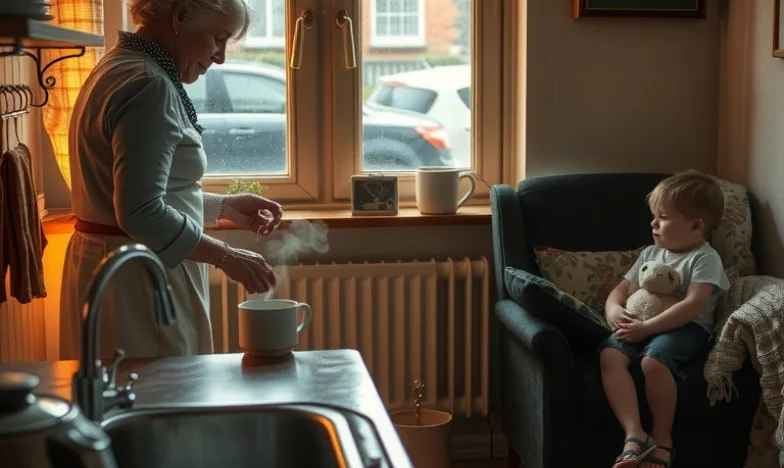
The question hit me like a slap. I was standing at the kitchen sink, hands deep in soapy water, when little Jamie’s voice floated in from the living room. His words hung in the air, heavier than the rain battering the windows of my terraced house on High Street. I dried my hands, heart thumping, and walked in to find him curled up on the sofa, clutching his battered teddy.
“Jamie, love, what makes you say that?” I tried to keep my voice steady, but my mind was racing. Lucinda had always been the strong one, the one who never let her guard down, not even with me. Now she was in hospital, and I was left to care for her son, thinking I knew everything there was to know about my own family. How wrong I was.
He looked up at me, his big brown eyes searching my face for answers. “I hear her sometimes, Gran. At night. She thinks I’m asleep, but I’m not. She cries and talks to herself. She says she’s sorry.”
I sat beside him, pulling him close. The warmth of his small body was a comfort, but his words chilled me to the bone. What was Lucinda sorry for? What pain was she carrying that she’d hidden from everyone, even me?
The days blurred together after that. I tried to keep things normal for Jamie—school runs, fish fingers for tea, reading stories at bedtime. But every time I looked at him, I saw the shadow of worry in his eyes, the same shadow I’d seen in Lucinda’s before she was admitted to hospital. The doctors said it was exhaustion, stress, maybe something more. They didn’t know. I didn’t know. All I had were questions.
One afternoon, as we walked home from the corner shop, Jamie tugged at my hand. “Gran, can I tell you a secret?”
“Of course, darling. You can tell me anything.”
He hesitated, glancing around as if the wind might carry his words away. “Mum said not to tell anyone, but I think you should know. Sometimes, when she’s sad, she goes to the old house on Willow Lane. She says it’s where she left her heart.”
I stopped in my tracks. The old house on Willow Lane had been empty for years, ever since the Harrisons moved away. Why would Lucinda go there? What did she mean, she left her heart?
That night, after Jamie was asleep, I sat at the kitchen table, staring at the chipped mug in my hands. Memories flooded back—Lucinda as a little girl, running down High Street with scraped knees and wild hair, always so full of life. When did that light go out? What had I missed?
The next morning, I decided I needed answers. I called the hospital, but Lucinda was too tired to talk. So I did the only thing I could: I walked to Willow Lane.
The house stood silent, its windows boarded up, garden overgrown. I pressed my hand against the gate, feeling the rough wood beneath my palm. Suddenly, I heard footsteps behind me. I turned to see Mrs. Patel from the corner shop, her arms full of groceries.
“Morning, Margaret. What brings you here?”
I hesitated, unsure how much to say. “Just… memories, I suppose. Did you ever see anyone here? Recently?”
She nodded, lowering her voice. “Your Lucinda comes by sometimes. Sits on the steps for hours. I thought she was just reminiscing, but… she looked so lost.”
Lost. The word echoed in my mind as I walked home. What was Lucinda searching for? What pain was she carrying?
That evening, Jamie found me in the garden, staring at the wilting roses. “Gran, do you miss Granddad?”
The question caught me off guard. “Every day, love. Why do you ask?”
He shuffled his feet, looking down. “Mum says she misses someone too. Someone she can’t talk about.”
My heart ached. Lucinda had never spoken of anyone after her father died. She’d thrown herself into work, raising Jamie on her own, never letting anyone close. Was there someone she’d loved and lost? Someone she couldn’t tell me about?
Days passed, each one heavier than the last. Jamie grew quieter, his laughter fading. I tried to fill the silence with stories of when Lucinda was young, hoping to bring some light back into his eyes. But the questions lingered, unspoken.
One night, as I tucked Jamie into bed, he whispered, “Gran, do you think Mum will come home soon?”
I brushed his hair back, forcing a smile. “I hope so, darling. She loves you very much.”
He nodded, tears glistening in his eyes. “I love her too. Even when she’s sad.”
After he fell asleep, I sat in the dark, listening to the quiet hum of the house. I thought about all the things I didn’t know about my own daughter, all the secrets she’d kept hidden. I wondered if I’d failed her somehow, if I’d been too wrapped up in my own grief to see hers.
The next day, the hospital called. Lucinda was awake and wanted to see me. My heart pounded as I made my way to her room, the sterile smell of disinfectant filling my nose. She looked so small in the hospital bed, her hair pulled back, eyes rimmed with exhaustion.
“Mum,” she whispered, reaching for my hand. “I’m sorry.”
I squeezed her fingers, tears prickling my eyes. “For what, love?”
She looked away, her voice barely audible. “For not telling you. For shutting you out. I just… I didn’t want you to worry.”
I stroked her hand, my own voice trembling. “Lucinda, you don’t have to carry everything on your own. Whatever it is, we’ll face it together.”
She took a shaky breath. “After Dad died, I felt so alone. I tried to be strong for Jamie, but I was falling apart inside. I met someone, Mum. Someone who made me feel alive again. But it ended badly. He left, and I never told anyone. I thought if I pretended it didn’t happen, the pain would go away. But it didn’t. It just grew.”
Tears streamed down her cheeks, and I pulled her into my arms. “Oh, love. You should have told me. You don’t have to hide your pain.”
She sobbed against my shoulder, years of hurt pouring out. “I’m so tired, Mum. I just want to be happy again.”
I held her, rocking gently, as if she were a child again. “We’ll get through this, Lucinda. You, me, and Jamie. We’re a family. We’ll find our way back.”
When I returned home, Jamie was waiting for me, eyes wide with hope. “Is Mum okay?”
I knelt beside him, pulling him close. “She’s going to be alright, love. She just needs some time. And she loves you more than anything in the world.”
He smiled, relief flooding his face. “I knew she did.”
That night, as I watched Jamie sleep, I realised how much I’d taken for granted. I thought I knew my family, thought I understood their pain. But I’d been blind to the struggles they faced, the secrets they carried. It took a child’s honesty to open my eyes, to remind me that love isn’t just about being there in the good times, but about holding each other through the storms.
Now, as I sit by the window, watching the rain fall on High Street, I wonder: How many secrets do we keep from those we love, thinking we’re protecting them? And what would happen if we dared to share our pain, to let others in? Perhaps that’s the real secret of family—not the things we hide, but the courage to face the truth together.
Would you have seen the signs? Or do we all wear masks, even with those closest to us?