Kitchen Nightmares: My Battle with Mother-in-Law Margaret

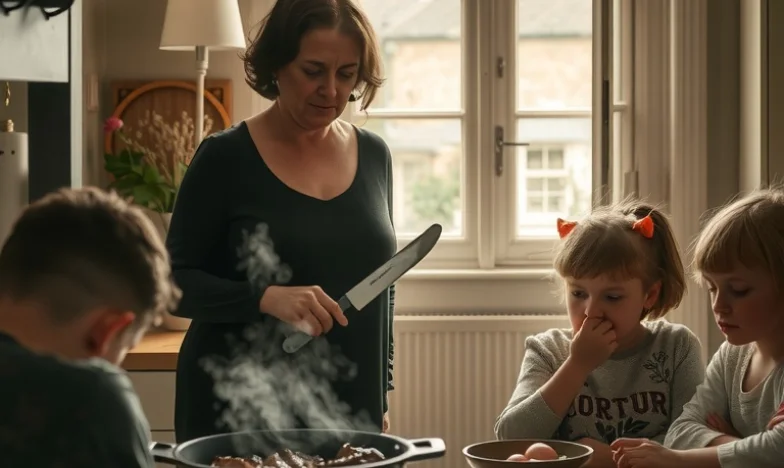
‘You call that a roast, Emily? My Michael always liked his beef pink, not grey as a London sky.’ Margaret’s voice sliced through the kitchen, sharp as the carving knife she wielded with unnecessary flourish. I stood by the oven, hands trembling, the scent of overcooked beef mingling with my humiliation. My husband, Michael, sat at the table, eyes glued to his phone, pretending not to hear. My daughter, Sophie, picked at her peas, cheeks flushed with embarrassment.
I wanted to scream. Instead, I forced a smile, the kind you wear at funerals. ‘I’m sorry, Margaret. I’ll try to remember next time.’
She sniffed, unimpressed. ‘You said that last Sunday. And the Sunday before. Honestly, I don’t know how you manage. Back in my day, a woman took pride in her home. My kitchen was spotless, my dinners the talk of the street. Michael never went hungry, did you, love?’
Michael mumbled, ‘No, Mum,’ without looking up. I caught his eye for a second, pleading for support, but he only shrugged, as if to say, ‘What do you want me to do?’
It’s always like this. Ever since we moved to this sleepy town in Kent, Margaret’s made it her mission to remind me I’m not good enough. She lives just three streets away, close enough to pop round unannounced, arms full of Tupperware and unsolicited advice. I’d hoped for a fresh start here, a place to raise Sophie away from the chaos of London. Instead, I found myself in a different kind of chaos—one that crept into every corner of my home.
The worst part? I used to love cooking. I’d spend hours experimenting with recipes, filling the house with the smell of cinnamon and rosemary. Now, every meal feels like a test I’m doomed to fail. Margaret’s voice echoes in my head even when she’s not here: ‘Too much salt, Emily. You’ve burnt the onions, Emily. That’s not how you mash potatoes, Emily.’
Last week, she turned up while I was making shepherd’s pie. She hovered behind me, arms folded, watching every move. ‘You’re using instant mash? Oh, Emily, no wonder Michael’s lost weight. You can’t cut corners with family.’
I snapped, ‘I work full-time, Margaret. Sometimes I need shortcuts.’
She tutted. ‘When I was your age, I worked, raised three children, and still made everything from scratch. It’s about priorities, dear.’
I wanted to throw the potato packet at her. Instead, I bit my tongue so hard I tasted blood.
After she left, Michael found me in the bathroom, sobbing into a towel. ‘She doesn’t mean it,’ he said, awkwardly patting my back. ‘She’s just… old-fashioned.’
‘She’s cruel,’ I spat. ‘And you let her be.’
He sighed. ‘She’s my mum. She’ll never change.’
But why should I be the one to change? Why should I shrink myself to fit Margaret’s idea of a perfect wife? I wanted to scream at him, at her, at the whole bloody town for making me feel so small.
The next Sunday, I decided to fight back. I spent all morning preparing a roast—free-range chicken, homemade Yorkshire puddings, even a sticky toffee pudding for dessert. I scrubbed the kitchen until it gleamed. When Margaret arrived, I greeted her with a smile that felt more like a challenge.
She sniffed the air. ‘Smells… different.’
‘It’s lemon and thyme,’ I said, daring her to criticise.
At the table, she poked at her food, searching for faults. ‘Chicken’s a bit dry,’ she said eventually. ‘But the Yorkshires are passable.’
I clenched my fists under the table. Michael cleared his throat. ‘I think it’s lovely, Em.’
Margaret raised an eyebrow. ‘Well, you would say that.’
Sophie piped up, ‘Mummy made pudding too!’
Margaret smiled at Sophie, softening for a moment. ‘Did she now? Well, let’s see if it’s as good as mine.’
We ate in silence, the tension thick as gravy. After dessert, Margaret stood to leave. ‘Thank you for dinner, Emily. I suppose it’s the thought that counts.’
When the door finally closed behind her, I collapsed onto the sofa, exhausted. Michael sat beside me, silent. I wanted him to say something—anything—to acknowledge how hard I’d tried. Instead, he scrolled through his phone, oblivious.
That night, I lay awake, replaying every word, every look. I thought about my own mum, gone now, who’d taught me that love was more important than a spotless kitchen. She’d have told Margaret where to stick her Yorkshire puddings. I wished I had her courage.
The next morning, I found a note on the kitchen table. Margaret’s handwriting, neat and precise: ‘Emily, I’ve signed us up for the village bake-off. Thought it might help you improve your skills. See you Saturday. Margaret.’
I crumpled the note in my fist, heart pounding. Was this her way of helping, or another chance to humiliate me in front of the whole village?
Saturday came too quickly. The village hall buzzed with chatter and the smell of sugar. Margaret arrived in her best apron, lips pursed. ‘Ready, Emily?’
I nodded, though my hands shook. We were to bake a Victoria sponge together. Margaret took charge, barking orders. ‘Not like that! Fold, don’t stir. You’ll knock out the air.’
I gritted my teeth, trying to keep up. My sponge came out lopsided, jam oozing from the sides. Margaret’s was perfect, of course. She smirked as the judges tasted our cakes.
When they announced the winner—Margaret, naturally—she patted my arm. ‘Better luck next time, dear.’
I fled to the car park, tears streaming down my face. Michael found me there, shivering in the drizzle. ‘Em, come on. It’s just a cake.’
‘It’s not just a cake!’ I shouted. ‘It’s every bloody Sunday, every snide comment, every time she makes me feel like I’m not good enough for you, for Sophie, for this family!’
He looked stunned. ‘I didn’t realise—’
‘Of course you didn’t. You never do. You let her walk all over me, and I’m done. I can’t keep living like this, Michael. Something has to change.’
For once, he didn’t have an answer.
That night, I sat at the kitchen table, staring at the mess of flour and jam. Sophie crept in, clutching her teddy. ‘Mummy, I like your cake best.’
I pulled her into my lap, tears falling onto her hair. ‘Thank you, sweetheart.’
The next day, I called Margaret. My voice shook, but I forced myself to speak. ‘Margaret, I appreciate your help, but I need you to stop criticising me in my own home. I’m doing my best, and I’d like you to respect that.’
There was a long pause. ‘I only want what’s best for Michael and Sophie.’
‘So do I. But I need to do it my way.’
She hung up without another word. I expected to feel triumphant, but instead I felt empty, scared of what would come next.
Weeks passed. Margaret stopped coming round. The house felt lighter, but lonelier too. Michael was distant, unsure how to bridge the gap between us. I threw myself into work, into Sophie, into rediscovering the joy of cooking for myself.
One Sunday, Michael came into the kitchen as I pulled a tray of scones from the oven. ‘Mum called,’ he said. ‘She wants to come for tea.’
I hesitated. ‘Only if she’s willing to be civil.’
He nodded. ‘I told her that. She said she’d try.’
Margaret arrived, quieter than usual. She complimented my scones, even asked for the recipe. It wasn’t perfect, but it was a start.
Now, as I sit here, watching Sophie lick jam from her fingers, I wonder: Why do we let others define our worth? Why is it so hard to stand up for ourselves, even in our own homes? Maybe it’s time we all learned to set boundaries, to demand respect, to bake our own cakes—lopsided or not. Would you have done the same in my shoes? Or would you have let the kitchen nightmares continue?