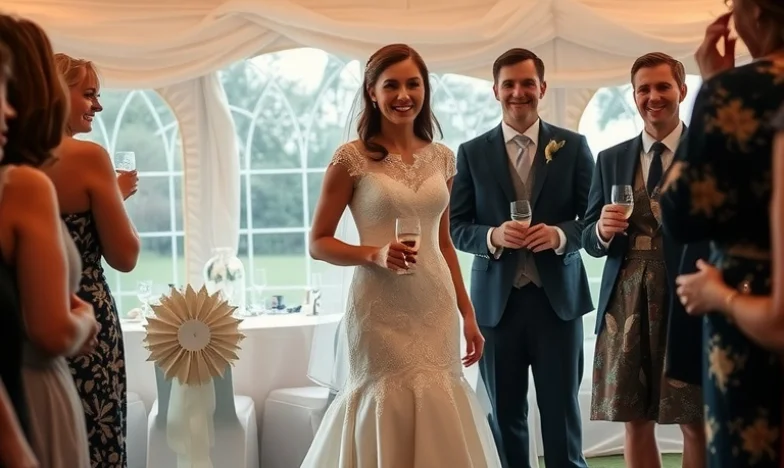
The Bride Refused to Be Overshadowed — Her Act Shocked Everyone

“You’re not wearing that dress, Emily. I won’t have my daughter looking like she’s off to a village fête.” Margaret’s voice sliced through the air, sharp as the silver cake knife she’d insisted on bringing from home. I stood in the hallway of Emily’s childhood house in Surrey, clutching my tie, my palms sweating. The morning sun filtered through the stained-glass window, painting the carpet in fractured colours, but all I could see was the tension between mother and daughter.
Emily’s hands trembled as she smoothed the delicate lace of her gown. “Mum, this is the dress I chose. I love it.”
Margaret’s lips curled. “You could do better. You always could.”
I wanted to step in, to defend Emily, but the words stuck in my throat. This was their battle, and I was just a spectator, as I’d been since the engagement. Margaret had always been a force of nature — the sort of woman who could silence a room with a glance, who never accepted less than perfection, especially from her only daughter. She’d orchestrated every detail of our wedding, from the flowers to the seating chart, as if it were her own.
But Emily, my Emily, had a quiet strength. She’d endured her mother’s criticisms for years, but today, I saw something different in her eyes: a flicker of defiance.
The drive to St Mary’s Church was silent, save for Margaret’s running commentary on the weather, the traffic, the state of the vicar’s garden. Emily stared out the window, her jaw set. I reached for her hand, and she squeezed it, hard.
At the church, guests milled about, their laughter echoing off the ancient stone walls. My best man, Tom, clapped me on the back. “Ready, mate?”
I nodded, but my stomach churned. I caught sight of Margaret, already directing the ushers, her hat perched at a jaunty angle. She looked as if she owned the place.
The ceremony began. Emily walked down the aisle, radiant despite the storm brewing behind her eyes. As we exchanged vows, I saw Margaret in the front pew, arms folded, lips pursed. When the vicar asked if anyone objected, I held my breath. Margaret’s eyes narrowed, but she said nothing.
The reception was held at a country house, all manicured lawns and white marquees. Margaret had spared no expense — or so she reminded everyone, loudly. The speeches began. My father told embarrassing stories from my childhood; Tom made everyone laugh with tales from uni. Then Margaret stood, glass in hand.
“I’d like to say a few words,” she announced, her voice ringing out. “Emily, you’ve always been a… spirited girl. I suppose I should be grateful you’ve found someone willing to put up with you.”
A ripple of awkward laughter. Emily’s cheeks flushed. I felt anger rising in my chest.
Margaret continued, “I only hope you’ll learn to listen, to take advice from those who know better. Marriage is about compromise, after all.”
Emily’s eyes met mine. I saw the hurt, the humiliation. But then, she stood.
“Thank you, Mum,” Emily said, her voice steady. “But today isn’t about compromise. It’s about love, and respect. And I won’t let anyone — not even you — make me feel small on my wedding day.”
The room fell silent. Margaret’s face froze, her glass halfway to her lips. For a moment, no one moved.
Then Emily turned to me, her eyes shining. “I love you, James. And I’m proud of the woman I am — the woman you love.”
Applause broke out, hesitant at first, then growing. Margaret sat down, her authority crumbling. For the first time, Emily stood taller than her mother.
Afterwards, guests approached us, offering hugs and congratulations. “That was brave,” my aunt whispered. “About time someone put Margaret in her place.”
Later, as the sun set and the band played our first dance, I held Emily close. “You were incredible,” I murmured.
She smiled, tears in her eyes. “I just couldn’t let her ruin this for us. Not today.”
Margaret lingered at the edge of the dance floor, her expression unreadable. She left early, without saying goodbye.
That night, as we lay in our hotel room, Emily stared at the ceiling. “Do you think she’ll ever forgive me?”
I squeezed her hand. “You did what you had to do. For us.”
Weeks passed. Margaret’s calls were less frequent, her tone clipped. But Emily was lighter, freer. She started painting again, something she’d given up years ago. Our home filled with colour and laughter.
One Sunday, Margaret appeared at our door, unannounced. She looked older, smaller somehow. “May I come in?”
Emily hesitated, then nodded.
Over tea, Margaret fidgeted with her cup. “I suppose I owe you an apology,” she said at last. “I only wanted the best for you. But perhaps I went about it the wrong way.”
Emily’s eyes softened. “I know you love me, Mum. But I need to live my own life.”
Margaret nodded, tears glistening. “I see that now.”
As she left, Margaret hugged Emily tightly. “You were beautiful on your wedding day. I’m sorry I didn’t say it then.”
After she’d gone, Emily turned to me, her voice trembling. “Do you think it’s possible to break free from the past, and still keep your family close? Or must we always choose between ourselves and those we love?”